Get Full Government Meeting Transcripts, Videos, & Alerts Forever!
Committee lays over bill to stabilize compensatory revenue, creates task force to review formula
Summary
The House Education Finance Committee on March 18 laid over House File 7,045, a bill that would restore meal application forms to compensatory revenue counts for fiscal 2026, create a task force to review the compensatory formula, and provide short‑term funding to limit abrupt district losses.
The House Education Finance Committee on March 18 laid over House File 7,045 for possible inclusion in the education finance bill, a proposal that would restore use of free and reduced‑price meal application forms alongside direct certification counts for compensatory revenue, create a task force to reexamine the formula, and provide near‑term funding to reduce abrupt district losses.
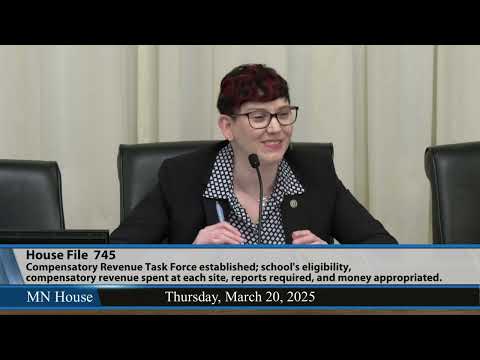
The bill’s sponsor, Representative Hannah Feist, told the committee compensatory revenue "targets students who are underprepared to learn and not meeting academic standards" and that the measure seeks both short‑term stability and a long‑term reexamination of how the state identifies students who generate that aid. Representative Feist presented the bill and the motion that it be laid over for possible inclusion in the education finance omnibus.
Why it matters: Compensatory revenue is a sizeable element of Minnesota’s K‑12 funding. House fiscal staff summarized the bill’s cost and how the formula counts students; the fiscal note and supporting runs show large, district‑level variation in impacts when meal application forms are removed from the calculation. Committee members and multiple testifiers said abrupt changes in the count could force districts to cut staff or programs this spring and summer.
Key fiscal and technical details: Solve Bekle of House Fiscal reported the bill’s biennial cost estimates on the fiscal note: an estimated $420,612,000 for the fiscal 2026 portion and $492,121,000 for the…
Already have an account? Log in
Subscribe to keep reading
Unlock the rest of this article — and every article on Citizen Portal.
- Unlimited articles
- AI-powered breakdowns of topics, speakers, decisions, and budgets
- Instant alerts when your location has a new meeting
- Follow topics and more locations
- 1,000 AI Insights / month, plus AI Chat