Get Full Government Meeting Transcripts, Videos, & Alerts Forever!
Get email alerts on the Compensatory Revenue topic
No spam. Unsubscribe anytime.
Committee lays over bill to stabilize compensatory revenue, creates task force to review formula
Summary
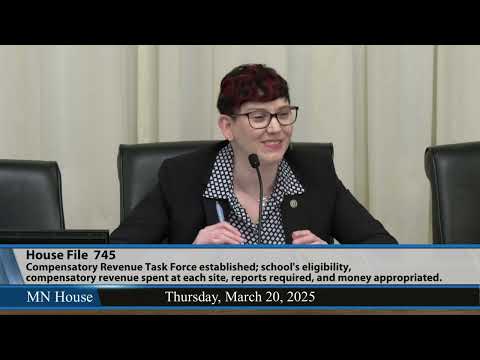
The House Education Finance Committee on March 18 laid over House File 7,045, a bill that would restore meal application forms to compensatory revenue counts for fiscal 2026, create a task force to review the compensatory formula, and provide short‑term funding to limit abrupt district losses.
The House Education Finance Committee on March 18 laid over House File 7,045 for possible inclusion in the education finance bill, a proposal that would restore use of free and reduced‑price meal application forms alongside direct certification counts for compensatory revenue, create a task force to reexamine the formula, and provide near‑term funding to reduce abrupt district losses.
The bill’s sponsor, Representative Hannah Feist, told the committee compensatory revenue "targets students who are underprepared to learn and not meeting academic standards" and that the measure seeks both short‑term stability and a long‑term reexamination of how the state identifies students who generate that aid. Representative Feist presented the bill and the motion that it be laid over for possible inclusion in the education finance omnibus.
Why it matters: Compensatory revenue is a sizeable element of Minnesota’s K‑12 funding. House fiscal staff summarized the bill’s cost and how the formula counts students; the fiscal note and supporting runs show large, district‑level variation in impacts when meal application forms are removed from the calculation. Committee members and multiple testifiers said abrupt changes in the count could force districts to cut staff or programs this spring and summer.
Key fiscal and technical details: Solve Bekle of House Fiscal reported the bill’s biennial cost estimates on the fiscal note: an estimated $420,612,000 for the fiscal 2026 portion and $492,121,000 for the subsequent biennium tabled in the committee packet. Bekle also summarized task force cost estimates (about $110,000 in FY26 for per diem, mileage and minor reimbursements for non‑agency members) and cited the Minnesota Department of Education’s explanation about how compensatory revenue is calculated under Minnesota Statutes chapter 126C (the compensatory formula reference appears in the department materials as 126C.10). Committee analyst Thomas Strom walked members through district‑level runs showing counts and revenue under multiple scenarios: fiscal 2024, fiscal 2025, a fiscal 2026 baseline relying on direct certification only, and the fiscal 2026 result under House File 7,045. The packet shows a direct certification count of about 310,190 students and 42,313 students identified via application forms in the cited summary pages.
Testimony and concerns: Speakers representing districts, teachers and advocacy groups urged a near‑term fix. Zena Stenvick, superintendent of Columbia Heights Public Schools and member of the Association of Metropolitan School Districts, said Columbia Heights faces "an unprecedented loss of nearly $3,700,000, which is over $1,000 per pupil" under the direct‑certification‑only approach, and urged continuation of a dual‑count option. Daniel Honig, president of the Columbia Heights Federation of Teachers, said the reduction "is equivalent to letting go of 35 teachers" at one elementary school and warned of larger class sizes and reduced supports. Other superintendents and finance directors gave similar local impact examples (reported in testimony: Round Lake superintendent described an estimated $329,000 loss for that district; Worthington was cited as facing a $2.7 million projected loss). Matt Shaver of EdAllies, which supports a wider review of the formula, urged adding paper forms back for the immediate count while a task force builds a better long‑term model.
State agencies and process: Ado Shuni, director of government relations for the Minnesota Department of Education (MDE), told the committee the administration supports a fiscal‑26 fix to provide stability while convening a working group to evaluate the formula’s purpose and measures. MDE noted that, although meal application forms are not currently counted for fiscal 2026 under current law, districts should continue to collect those forms for federal meal reimbursement and other programs.
Task force and policy questions: Representative Feist described the bill’s task force as a venue to gather geographically and technically diverse stakeholders to answer targeted questions: who should generate compensatory revenue; what proxies and data should be used; and how funds should be targeted and reported. Members debated whether the task force should include sitting legislators; Representative Feist said she designed the group to emphasize practitioner expertise but was open to adding legislative members. Several committee members, including Representative Bennett and others, urged that the task force explicitly examine effectiveness — whether compensatory revenue actually advances the academic outcomes it intends to support — in addition to formula mechanics.
Outcome and next steps: The committee laid House File 7,045 over for possible inclusion in the education finance omnibus (motion made from the gavel and renewed later in the hearing). The bill’s authors and agency staff said the task force and additional data runs would inform negotiations during omnibus bill drafting.
What remains unresolved: Exact district‑by‑district impacts depend on which counts and statutory adjustments are adopted; the bill includes placeholder funding (described in testimony as "dot dot dots") to mitigate abrupt losses while the task force studies the formula. Committee discussion noted open questions about measurement of program effectiveness, data collection burdens for districts, and whether the state should maintain building‑level protections that limit how much compensatory money may be shifted away from the school that generated it.
Sources: Testimony and fiscal presentations to the House Education Finance Committee, March 18, 2025, including Representative Hannah Feist (bill sponsor), Solve Bekle (House Fiscal), Thomas Strom (committee analyst), Zena Stenvick (Columbia Heights superintendent), Daniel Honig (Columbia Heights Federation of Teachers), Ado Shuni (Minnesota Department of Education), Matt Shaver (EdAllies), and district finance directors and superintendents.