Get Full Government Meeting Transcripts, Videos, & Alerts Forever!
Get email alerts on the State Grants topic
No spam. Unsubscribe anytime.
Private colleges urge Legislature to protect Minnesota State Grant funding
Summary
Leaders from Minnesota private colleges and a student told the House Higher Education Committee that a projected shortfall in the Minnesota State Grant program risks cutting awards for tens of thousands of students, and urged lawmakers to preserve funding.
Leaders of Minnesota private colleges told the House Higher Education Finance and Policy Committee on Tuesday that reductions in the Minnesota State Grant program would threaten access, completion and workforce pipelines for the state.
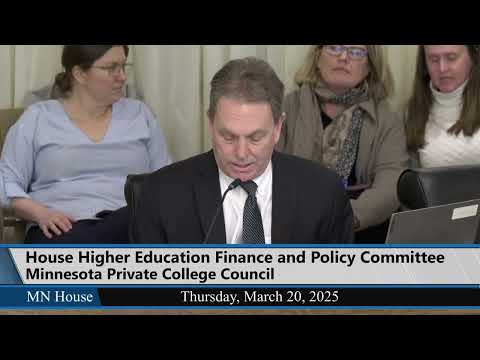
Paul Sirkvenik, president of the Minnesota Private College Council, told the committee the council’s 18 member institutions enroll more than 54,000 students and that “the shortfall in state grant funding is deeply concerning. If not addressed, this deficit could cause about 24,000 students of the 81,000 eligible students to lose their state grants entirely.”
The warning came during a panel that included presidents from the College of St. Scholastica and the University of St. Thomas and a student from St. Scholastica. The testimony emphasized the scale of private colleges’ economic and workforce contributions and the role of state need-based aid in keeping students enrolled and completing degrees.
Sirkvenik said the private colleges collectively report a $4.5 billion annual economic impact in Minnesota, employ more than 12,000 people and count 367,000 alumni living in the state. He also said the system awards institutional aid at a much higher rate than public grant funding: “For every $1 in state and federal grants to our students, our member institutions award $6 in institutional grants, scholarships, and discounts.”
Barbara McDonald, president of the College of St. Scholastica in Duluth, said about 80% of the college’s students come from Minnesota and 34% of St. Scholastica undergraduates receive the state grant. “None of this would be possible for our students without this support,” McDonald said, describing the grant as critical to the college’s ability to enroll and graduate students who often remain in Greater Minnesota to work.
Rob Fisher, president of the University of St. Thomas, said the institution is the largest private university in Minnesota and that one in three of its students rely on state grant aid. “We are committed to helping our students achieve a St. Thomas education in ways that are accessible despite what their own family economic background might be,” Fisher said.
A student speaker, Maddie Plouffe, a senior at St. Scholastica and a three‑year state grant recipient, told the committee she relied on the award to afford the college. Plouffe said that after a recent shortfall she received $800 this year when she expected about $2,000, forcing her to take a second job while also completing an unpaid internship: “Without the support of the Minnesota State grant, I would not have had the opportunities to do and study what I love.”
Committee members questioned presenters about graduation rates and institutional financials. Sirkvenik said the consortium’s overall four‑year graduation rate is 65 percent and that the four‑year rate for Pell‑eligible students is 56 percent, figures he said compare favorably with private colleges nationally.
The private college testimony preceded committee deliberations on Office of Higher Education policy and budget bills. Lawmakers and witnesses repeatedly framed the state grant conversation around portability — the program’s feature that allows aid to follow the student to a public or private campus — and around the committee’s responsibility to steward public resources across public and private institutions.
Ending
Committee members did not take final action on funding at the hearing. Private college leaders asked the Legislature to protect or restore state grant investment to avoid reductions in awards and potential enrollment and completion losses. The committee laid over subsequent OHE policy and budget bills for further consideration.