Get Full Government Meeting Transcripts, Videos, & Alerts Forever!
Get email alerts on the State Budget topic
No spam. Unsubscribe anytime.
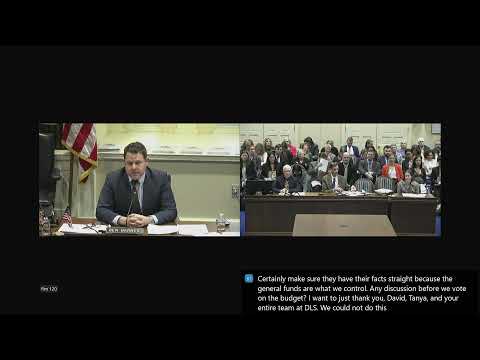
Maryland House Appropriations Committee approves budget package, restores major DDA funding
Summary
The House Appropriations Committee voted to adopt the fiscal package, approving full committee decisions and multiple subcommittee reports and restoring tens of millions for the Developmental Disabilities Administration and other priorities while approving tax and revenue changes to support the plan.
The House Appropriations Committee voted to adopt the fiscal 2026 budget package and related BRFAA decisions on May 20, approving subcommittee reports and a slate of revenue and policy changes the committee said are necessary to balance the state budget.
Committee leadership said the package includes substantial restorations to programs reduced earlier in the process and revenue provisions intended to support the capital program and other priorities. Committee Chair (unnamed) said the result is a balanced plan with a stronger rainy day fund and specific restorations for vulnerable populations.
Why it matters: The committee’s action finalizes the Appropriations Committee’s recommendations to the full House and reflects negotiations with the governor’s office and the Senate. The package combines spending reductions, restored funding, and new and adjusted revenues that supporters said preserve key services while meeting the state’s structural-balance objectives.
What the committee adopted - Final budget adoption: The full committee adopted the combined budget and BRFAA decisions by roll call. Committee leaders described the plan as structurally balanced, retaining an increased rainy day fund and cash balances. - Major restorations highlighted by the chair include substantial funding for the Developmental Disabilities Administration (DDA), research funding for academic health centers, and targeted funding for pediatric hospital overstays and other human services priorities. - Revenue actions: The committee approved an array of tax and revenue changes (summarized below) intended to fund transportation programs, support the capital program and produce general fund revenue.
Key program restorations and allocations - Developmental Disabilities Administration (DDA): The committee restored multi‑year funding to reverse several proposed cost‑containment actions. The package added $132,240,000 in general funds for fiscal 2026 and $15,000,000 in special funds from the Community Services Trust Fund to restore or modify several DDA proposals, including maintaining reasonable and customary wage levels, restoring dedicated support hours, and preserving the wage exception process, among other items. (Transcript references: additional pages, DDA legislative amendments.)
- Academic health research: The committee restored $15,000,000 for cancer research and related academic health center activities, reversing a prior proposal to cut that funding.
- Pediatric hospital overstays: The committee added $3,000,000 and a separate $3,000,000 adjustment (described in committee remarks as a related dedicated allocation), which committee leadership said together provide $6,000,000 to address pediatric hospital overstays.
- Other targeted allocations: The committee rejected proposed cuts to public defender positions and certain public safety grants in the public safety decisions and retained or restored funding for a number of human services programs identified during subcommittee deliberations.
Revenue and tax provisions (high‑level) - Income and surtax changes: The package, as considered by the committee, included modifications to the individual income tax structure described in the committee’s tax summary: an increase in certain standard deductions, new higher tax brackets for high earners, and a capital‑gains surcharge on large capital gains receipts with part of the revenue directed to the Transportation Trust Fund.
- Transportation revenue adjustments: The committee acted on multiple transportation revenue items (including accelerating certain vehicle excise/registration changes and increasing some fees) intended to support the Capital Transportation Program (CTP) and the Highway User Revenues referenced by committee members.
- Sales tax and other measures: The committee considered and moved forward a set of sales‑tax changes, including new tax treatment for certain data or IT services and adjustments to exemptions; several fee and licensing changes across agencies were also adopted.
How the committee decided and who spoke - Subcommittee reports: The committee adopted multiple subcommittee reports in sequence (Education; Health & Social Services; Transportation & Environment; Public Safety; and PAYGO/capital). Each adoption was moved and seconded and was approved either by roll call or voice vote during the meeting.
- Committee leadership and staff: Subcommittee chairs presented their reports. Department of Legislative Services (DLS) staff and committee counsel were frequently cited during the decision process; the committee chair closed the meeting with remarks emphasizing collaboration with the Senate and the governor’s office and noting the package’s fiscal targets (rainy day fund growth, cash balance and structural balance).
Votes at a glance - Education Subcommittee report — Motion to adopt moved by a member of the committee and seconded. Roll call produced approximately 15 yays and 5 nays; the subcommittee report was adopted. (Transcript roll call begins at 1686.145.)
- Health & Social Services Subcommittee report — Motion to adopt; roll call yielded approximately 18 yays and 6 nays; the report was adopted. (Transcript roll call begins at 2302.875.)
- Transportation & Environment Subcommittee report — Motion to adopt; roll call produced approximately 16 yays and 4 nays; the report was adopted. (Transcript roll call begins at 2770.935.)
- Public Safety Subcommittee report — Motion to adopt was moved and seconded; the committee approved the report (voice vote and subsequent roll‑up discussion recorded). (Transcript: public safety discussion begins near 2864.79.)
- PAYGO (capital) Subcommittee report — Motion to adopt moved and seconded; the committee adopted the subcommittee report (voice vote). (Transcript: PAYGO discussion begins near 3331.26.)
- Final budget and BRFAA decisions — The full committee adopted the budget and BRFAA items by roll call. Recorded roll call produced approximately 17 yays and 8 nays; the motion to adopt the budget carried and the meeting adjourned. (Final roll call begins at 9033.055; meeting adjourned at 9093.864.)
Discussion vs. formal decisions - The transcript records substantial discussion and numerous contingent instructions (for example, multiple funding amounts were made contingent on pending reports or on the enactment of specific legislation). Where the transcript showed only discussion or a request for a report, the committee recorded narrative language or restrictions rather than adopting policy‑level changes in statute.
Procedural notes and next steps - Multiple budget items were made contingent on subsequent legislation or on DLS/DLS‑recommended technical adjustments; the committee noted that some supplemental actions will be revisited in supplemental budget work.
Ending - The committee chair closed the meeting by thanking DLS, committee counsel, and staff, and by emphasizing that the committee’s package seeks to protect vulnerable Marylanders while meeting fiscal targets. The committee’s actions now move forward as the Appropriations Committee recommendations in the legislative process.
(For clarity: the article summarizes the committee’s full committee decision meeting and large‑scale budget votes. Detailed line‑item or statutory text for each adopted motion is contained in the committee’s official decision documents and the BRFAA/decision packets referenced in the transcript.)