Get Full Government Meeting Transcripts, Videos, & Alerts Forever!
Get email alerts on the Utilities topic
No spam. Unsubscribe anytime.
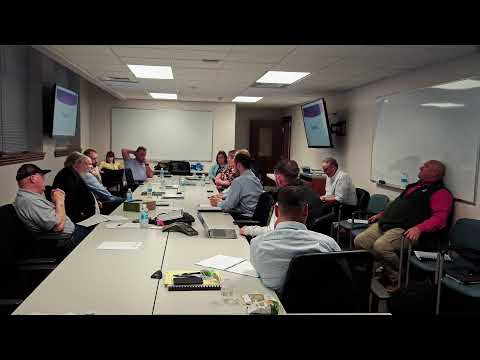
Pender County Utilities proposes staffing changes, meter upgrades and tap incentive as grants and cash fund next-year projects
Summary
Anthony Colon, Pender County utilities executive director, told the board at the retreat that the countys water and sewer enterprise holds roughly $68 million in outstanding debt and reported about $12.04 million in total utility revenues in the most recent audited year.
Anthony Colon, Pender County utilities executive director, told the board at the retreat that the countys water and sewer enterprise holds roughly $68,000,000 in outstanding debt and reported about $12.04 million in total utility revenues in the most recent audited year.
Colon said operating revenue available for debt service in fiscal 2024 was about $5.9 million and that debt service that year was about $4.1 million, producing roughly a 1.43 debt-service coverage ratio. He and Davenports analysis showed the utilities have tightened cash positions because of heavy capital spending but expect reserves to rebound as reimbursements and new connections materialize.
The utilities presentation outlined ongoing and planned projects for fiscal 202529 and 2026: a Maple Hill automatic meter infrastructure (AMI) replacement (meters, setters, boxes), a C. S. Hill elevated tank and well work, completion of a 421 corridor sewer/water extension (partly ARPA- and grant-funded), flood-control work at the Maple Hill wastewater plant and a distribution/collections facility on county-owned land. Colon said about $13 million of the FY26 $14.6 million CIP is grant-funded (ARPA or similar principal-forgiveness programs) and that other lines include USDA loans already on the books.
Colon described a multi-pronged operational plan: reorganize staffing (reclassifying and adding positions, including a chief treatment officer, a senior utilities inspector, an operations coordinator and a centralized maintenance group), complete the AMI rollout in-house, and reduce contract services by transferring maintenance work to county staff. "Were creating a centralized maintenance unit so we can start doing maintenance in house," Colon said.
On rates and fees, Colon said the utility system last year standardized residential base rates and charges by meter size and raised rates in a prior action. For the coming year he proposed raising the availability (base) fee for larger commercial meters (1.5-inch to 8-inch) to align with nearby utilities and cover the higher equipment and service costs for large service connections; residential base rates would not increase in the near-term under the proposal. He described planned meter purchases and installations and said some recent meters installed by developers required replacement.
To encourage service expansion, Colon proposed a time-limited tap-in incentive: a short-term program (e.g., a 90-day period to be proposed to the board) to offer roughly a 50% discount on tap costs for existing residences with a county water line in front of the property. "If you have a well and theres a water line in front of your house, this is only for residentials: were gonna be 50% for 90 days," Colon said, adding that billing staff would develop the program details for board approval.
Colon also told commissioners the utility is exploring a New Hanover County interconnection for emergency supply to reduce regional vulnerability and is evaluating the payoff of certain USDA loans if property sales free cash for debt reduction. He said the next steps include formal board action on any rate or fee changes, finalizing the AMI rollout plan and returning with the tap-in program language for approval.
The utility presentation emphasized two practical constraints: workforce retention and the timing of capital reimbursements. Colon said the department has struggled to retain certified operators against neighboring jurisdictions pay, prompting requested reclassifications and modest pay adjustments to reduce turnover. He urged that getting personnel and finances stable this year would let the county accelerate line extensions and prioritized connections in subsequent years.