Get Full Government Meeting Transcripts, Videos, & Alerts Forever!
Get email alerts on the Bylaws topic
No spam. Unsubscribe anytime.
OHA trustees debate bylaws language; approve liaison and staffing edits, reject removing 'chief' from administrator title
Summary
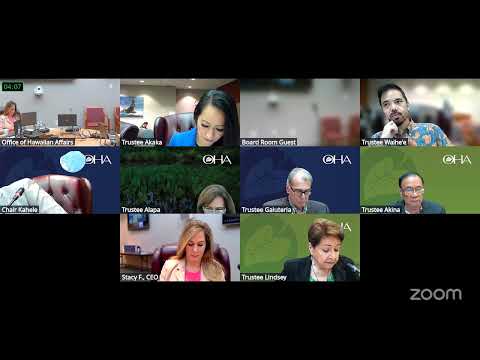
At its March 20 meeting, the Office of Hawaiian Affairs Board of Trustees held the second reading of proposed bylaws revisions intended to align OHA policies with state law and Sunshine Law and voted on several targeted amendments.
At its March 20 meeting, the Office of Hawaiian Affairs Board of Trustees took up the second reading of proposed revisions to the board bylaws intended to align OHA policy language with Hawaii law and the state Sunshine Law.
Trustees debated several specific edits and voted on amendments. The board approved, by roll call, an amendment to clarify the chairperson’s liaison role as “serve as a primary liaison with elected officials of county, state, and federal governments and other agencies and organizations” (vote: 8 yes). Trustees also voted to add language expanding the board secretary’s duties into the chief of staff’s position description (vote: 8 yes). A separate amendment to remove the word “chief” from the sentence “the administrator shall function as the chief executive officer” failed (vote: 5 yes, 3 no), leaving that phrasing in the draft.
Why it matters: the bylaws are the board’s foundational governance document. Trustees said the draft updates are intended to bring OHA into alignment with Chapter 10 of the Hawaii Revised Statutes and with Sunshine Law requirements, and to modernize descriptions of board officers and staff duties.
Discussion highlights - Chair Kahele framed the changes as a technical and statutory alignment with HRS Chapter 10 and Sunshine Law, noting the revisions cover succession, committee agenda approval, testifier rules and other procedural matters. - Trustee Akaka proposed multiple edits (county liaison language, staff‑description changes and others) and asked that the board vote on them separately. - Trustee Acosta (spoke under the name “Trustee Acosta” in the record) argued in favor of retaining the phrase “administrator shall function as the chief executive officer,” saying the CEO title helps with external recognition and recruitment. - Everett Ota, interim corporation counsel, explained that some of the expanded staff duties were drawn from existing position descriptions and the chair directed more descriptive listings be included in the draft.
What trustees decided (selected votes) - Amendment to identify the chair’s primary liaison role with elected officials at county, state and federal levels: passed by roll call, 8‑0. - Amendment to incorporate language from the board secretary role into the chief of staff’s position description: passed by roll call, 8‑0. - Amendment to remove the word “chief” from the sentence describing the administrator as a CEO (change intended to read “administrator shall function as the executive officer”): failed, 5‑3 (a 2/3 supermajority of trustees is required to adopt bylaw changes).
Next steps and process points Trustees emphasized that bylaw revisions require a supermajority (two‑thirds) under the board’s rules to adopt. Multiple speakers noted that adopting bylaw language will trigger additional updates across OHA materials (for example, the executive policy manual and operations manuals) to ensure consistent titles and delegations of authority. Several trustees said they intend to continue reconciling wording across those documents after the bylaws move forward.
Attribution (selected speakers who took substantive part in this item): Chair Kahele (Board chair); Trustee Akaka; Trustee Acosta; Trustee Akina; Trustee Alapa; Trustee Galluteria; Trustee Lindsay; Everett Ota (Interim Corporation Counsel).
Ending Trustees discussed proceeding by considering each proposed amendment on its own and noted that some outstanding drafting and alignment work remains for the executive policy manual and other governance documents. No single consolidated final adoption of the full revised bylaws is recorded in the transcript as completed at the close of the discussion; the record shows votes on the individual amendments described above.