Get Full Government Meeting Transcripts, Videos, & Alerts Forever!
Get email alerts on the Budget And Finance topic
No spam. Unsubscribe anytime.
Airport posts midyear gains: passengers up, parking drives revenue; PFAS testing and capital projects drive spending
Summary
Business manager Jonathan Abad reported midyear (July–December 2024) growth at Santa Barbara Airport—passenger counts up 15.3% at midyear and July 2024 recorded a 21.3% year‑over‑year increase—while expenses rose due to PFAS testing, extraordinary repairs and capital work; commissioners asked about encumbrances, staffing and parking plans
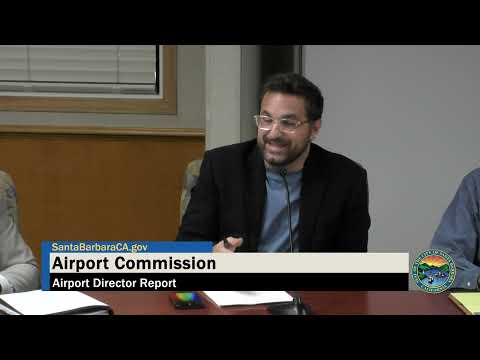
Jonathan Abad, business manager for the Santa Barbara Airport, presented the airport’s fiscal midyear financial review for July through December 2024 at the commission’s March 13 meeting, reporting record passenger counts and revenue gains alongside higher operating and special‑project costs.
Abad told commissioners that July 2024 was the airport’s highest monthly passenger count on record and that at midyear total passengers were up 15.3% year over year. He said most major revenue categories increased: terminal revenues were up 23% (parking up nearly 31%), commercial aviation revenues up 10%, and concessions up 15% compared with the prior midyear period.
“Parking is really now key to the airport’s fiscal sustainability,” Abad said, noting a recent parking equipment replacement (Skidata to TIBA) that reduced equipment downtime and improved real‑time monitoring. Abad said terminal and airline‑driven revenues accounted for about 63% of midyear revenues.
On the expense side, Abad reported salaries and benefits rose 13.85% and materials/supplies/services rose about 19.4% due to extraordinary repairs. He cited a $350,000 generator‑radiator repair that required rental of a large replacement generator during work, and ongoing PFAS (per‑ and polyfluoroalkyl substances) testing and remediation planning required by the Regional Water Quality Control Board (RWQCB) as a major special‑project cost driver.
Abad outlined capital projects planned or underway, including the long‑term south parking project (design nearly complete; cost referenced as a little over $5,000,000) and relocation of an airport building tied to future FBO redevelopment (approximately $1,700,000). He said many capital projects expect FAA Airport Improvement Program grants; staff described some flexibility to delay capital spending if grant timing or priorities change.
Commissioners asked about how much of the budgeted capital transfers were encumbered; Abad said the midyear report did not break out an exact encumbrance figure but that some funds would carry forward and that major projects could be deferred if needed. On staffing, Abad said vacancies had improved and recruitment was proceeding well; additional hires were reducing the variance between budgeted and actual salary spending.
Other operational notes included installation of six level‑2 EV charging stations to support airport fleet electrification (staff said public fast chargers are still under consideration), completion of airfield marking and lighting work, and the airport’s nomination in Newsweek’s 2025 “best small airport” reader choice award. Abad asked commissioners to vote in the public poll; he said voting was open through April 10 (Pacific time).
Ending — Commissioners praised the revenue performance and asked staff to continue monitoring encumbrances and the timing of FAA grants. Staff said they would return with additional detail on encumbrances and project timing as the budget process continues.