Get Full Government Meeting Transcripts, Videos, & Alerts Forever!
Get email alerts on the Housing Policy topic
No spam. Unsubscribe anytime.
Cochise County housing director previews 5-year plan, cites voucher growth and waiting-list strain
Summary
Housing Authority of Cochise County Director Anita Baca briefed the Board of Supervisors on the authority's HUD-required five-year plan, outlining goals on inspections, fair housing, and self-sufficiency while reporting expanded voucher allocations and roughly 800 households on the waiting list.
The Housing Authority of Cochise County told the Board of Supervisors on March 20 that it will submit a HUD five-year plan that emphasizes maintaining program performance, ensuring housing quality, and expanding assisted housing while managing a waiting list of nearly 800 households.
"Our mission is to provide safe decent sanitary housing conditions for low fam low income families and to manage resources efficiently," Housing Director Anita Baca told the board during a work session in the Supervisor's Hearing Room.
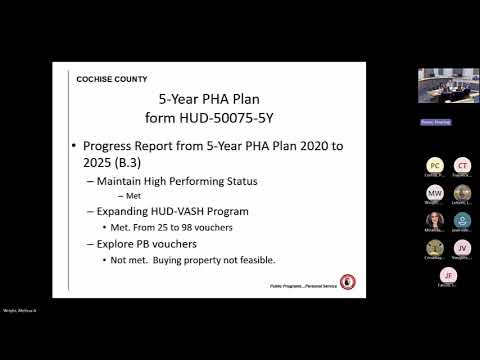
Baca said the authority's priorities for the five-year plan (HUD form 50075) include remaining a high performer under HUD's Section 8 Management Assessment Program, conducting required inspections, affirmatively furthering fair housing, promoting self-sufficiency through the Family Self-Sufficiency program and applying for additional vouchers if they become available.
The housing authority reported several program changes and expansions since the last five-year plan. It increased its HUD VASH vouchers for veterans from 25 to 98, and absorbed Douglas's voucher allocation after Douglas divested, adding 193 vouchers into the combined Cochise County inventory. Baca said the agency also added roughly 210 housing choice, special-purpose and emergency housing vouchers in recent action.
On demand for assistance, Baca said, "we still have close to 800 folks on our waiting list that applied from last year." She described the authority's practice of pulling applicants from the waiting list in chronological order, with HUD-required adjustments that prioritize specified preferences, such as residency, veteran status, disability, domestic violence and chronic homelessness.
Baca described inspection practices and a pending HUD change: in addition to annual and move-in/move-out inspections the authority performs biannual inspections for multifamily properties that self-inspect or have a strong maintenance record. "We are going to transition to the NSPIRE, which is the new HUD inspection system. If HUD follows through with transitioning to that," she said, adding that the timing remains uncertain.
On fair housing and domestic violence protections, the authority said it partners with the Southwest Fair Housing Council to provide seminars for landlords and tenants and to field referrals. The authority also said it tracks Violence Against Women Act (VAWA) protections, coordinates with local domestic-violence shelters and law enforcement, and uses the Enterprise Income Verification (EIV) system to check for problematic matches such as duplicate vouchers or tenancy.
Baca described a policy change the housing authority has implemented in its administrative plan requiring owners to justify rental increases submitted for tenants in the program, permitting only one request per tenant in a 12-month period and capping increases at 10% of the contracted rent. She framed the change as a response to some multifamily owners raising rents sharply after acquisitions. "The increase must not exceed 10% of the contracted rent," she said.
On targeted supports, Baca recommended adding an application goal for a small number of vouchers targeted to people aging out of foster care. She said Department of Child Services recommended five vouchers for the county and the authority would pursue the application if the board wanted it listed in the five-year goals. After discussion, Baca said she would add the foster-youth voucher application to goals to pursue over the next five years.
Baca also reported outreach and grant considerations: the authority provides or coordinates fair-housing seminars (including a planned in-person landlord briefing), participates in continuum-of-care homeless coordination and point-in-time counts, and has discussed applying with county development services for a lead-based paint hazard control grant that would require additional staffing.
The board did not take a formal vote during the work session; the meeting was informational and intended to let staff discuss the draft five-year plan with supervisors prior to any formal action at a future public meeting.
Background details provided in the session included approximate income-limit ranges the authority uses for eligibility (Baca said extreme-low-income for a one-person household is "just over $18,000 a year," and the limit rises to about $50,000 for an eight-person household), and that most program funding and voucher allocations come directly from HUD, with some collaboration with the Arizona Department of Housing and local continuums of care.
The housing authority described its staff as seven employees who administer the federally funded programs, explained that the county processes payroll and charges administrative overhead to the grants, and reiterated that many program rules are set by HUD and verified through HUD reporting.
The work session ended without public comment (work sessions were announced as informational with no public comment), and the board moved on to other items on the agenda.