Get Full Government Meeting Transcripts, Videos, & Alerts Forever!
Get email alerts on the Homelessness topic
No spam. Unsubscribe anytime.
Committee approves HSH waiver to solicit donations for temporary shelter expansion
Summary
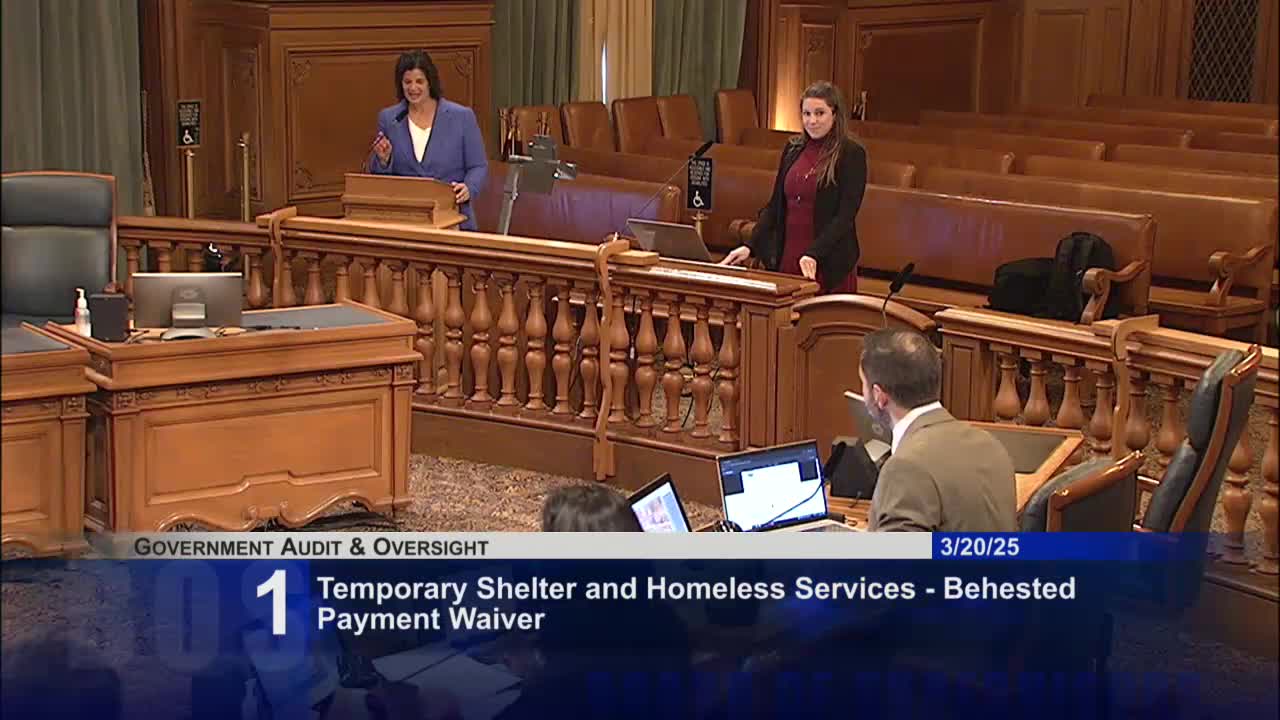
The Government Audit and Oversight Committee voted to forward a resolution authorizing the Department of Homelessness and Supportive Housing to solicit private donations to expand temporary shelter capacity, with reporting requirements and a narrowed list of staff covered by the waiver.
The Government Audit and Oversight Committee of the San Francisco Board of Supervisors on March 20 voted to forward a resolution authorizing the Department of Homelessness and Supportive Housing (HSH) to solicit donations from private and philanthropic entities to support expansion of temporary shelter and other homelessness services.
The measure, described by HSH Executive Director Shereen McSpadden as the department’s fourth behested payment waiver, narrows who may solicit donations to 10 leadership staff and includes a reporting requirement: the committee’s chair introduced an amendment requiring a report to the Board of Supervisors 60 days after the waiver’s expiration. The committee voted to forward the item to the full board with a positive recommendation. Chair Jackie Fielder, Vice Chair Sauter and Member Cheryl recorded aye votes.
McSpadden told the committee that the resolution would permit the department’s executive director, two chief deputy directors, four deputy directors and three program directors to engage philanthropic partners in order to secure funds for shelter and homelessness services. She said the current behested payment waiver was approved on Oct. 22, 2024 by Resolution 517-24 and will expire April 17, 2025. McSpadden described past public–private work with groups such as Tipping Point and named other philanthropic partners the department has worked with.
Committee members pressed staff on how donations would be used and how philanthropic engagement interacts with city policy. McSpadden said philanthropy generally “helps to support public policy” and gave prevention funding as an example of an area where private dollars can be especially useful. She described ongoing conversations about case management training and noted decisions about whether funds flow through a campaign vehicle or a lead agency had not been finalized.
The presentation included data McSpadden cited to explain the department’s needs: the 2024 point-in-time count found about 8,300 people experiencing homelessness in San Francisco, 52% unsheltered; as of February 2025, HSH reported 3,613 temporary shelter or crisis-intervention slots with a 93% occupancy rate. McSpadden also referenced the Home By The Bay strategic plan’s target for an investment that includes roughly 1,075 new shelter beds and a stated goal to reduce unsheltered homelessness by 50% in five years.
Chair Fielder’s amendment narrowed which HSH employees the waiver covers and added the 60‑day post-expiration reporting requirement; the amendment passed on a recorded roll call. With the amendment adopted, the committee voted to forward the item to the full Board of Supervisors with a positive recommendation.
No members of the public spoke on the item during the committee meeting.