Get Full Government Meeting Transcripts, Videos, & Alerts Forever!
Get email alerts on the Social Consumption topic
No spam. Unsubscribe anytime.
City staff briefs council on state social consumption rules; key limits include separation of consumption areas and ventilation/odor controls
Summary
City staff presented the state's draft social consumption framework and described local implications for indoor/outdoor smoking, three license types (supplemental, hospitality, event) and restrictions designed to isolate consumption and limit secondhand exposure.
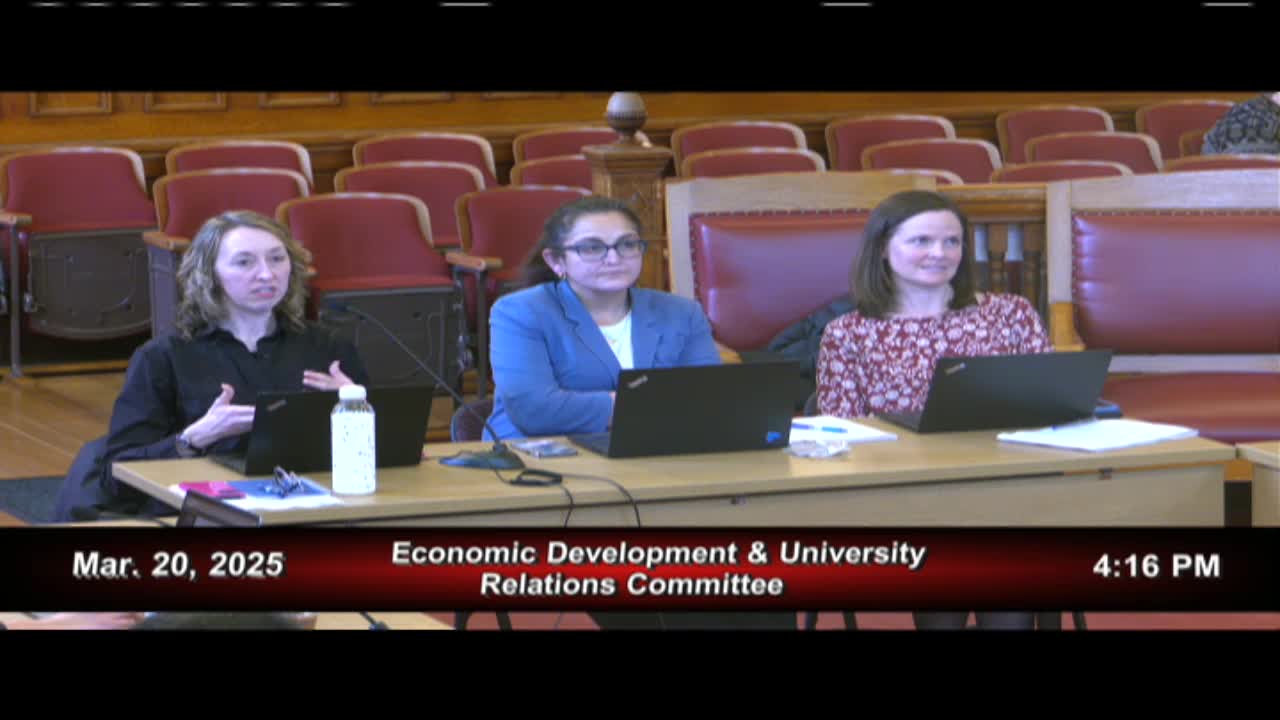
City staff briefed the Cambridge City Council's Economic Development and University Relations Committee on state draft regulations for social consumption of cannabis and highlighted local concerns such as indoor smoking limits, filtration and the separation of consumption areas from retail sales.
Christina Delicio of the Economic Opportunity and Development Division said the state first released draft regulations in December and has collected public feedback; staff provided the committee with the state's guidance as the basis for local discussion. "One thing that we should say right off the bat about social consumption, the state released their regulations as a first draft in December," Delicio said, noting the state had since collected feedback and that revisions were due to be released.
Delicio summarized three state license types that are most relevant to Cambridge: supplemental licenses (for existing cannabis establishments that want to add on-site consumption), hospitality licenses (for non-cannabis hospitality businesses that want to host consumption), and temporary event licenses (for festival-style or conference uses). She said supplemental licenses were the type the city would likely encounter most often because they apply to existing cannabis businesses wanting to add a consumption area.
Staff emphasized rules designed to limit exposure to smoke: consumption areas generally must be separated from sales areas by walls or barriers and often require secured, monitored doors; if a business proposes indoor smoking, the state expects adequate filtration to eliminate odor at the property line. Delicio noted a non-smoking option — e.g., consumption limited to edible marijuana-infused products (MIPs) — is available for operators who want to avoid the ventilation and secondhand-smoke issues.
"One of the reasons why the state has put forward this particular scheme...is because they are very worried about employee exposure to smoke or other consumers," Delicio said. She added the state also proposes a five-year priority period for economic empowerment, social equity, microbusiness and craft marijuana co-op applicants for social-consumption licenses.
Councilors asked clarifying questions. Vice Mayor Mark McGovern and others raised how indoor smoking for cannabis would intersect with Cambridge's existing municipal smoking prohibitions and workplace smoking rules. Delicio said the public health department would be involved and that staff would follow up with public health for more detailed guidance; she also said the state will review and approve layouts for designated consumption areas as part of licensing.
Committee members noted that, to date, Massachusetts has not broadly implemented social consumption sites, though Somerville has pursued the issue and the state's initial pilot approach drew limited interest. Councilors discussed waiting to act until the state finalizes rules and impacts become clearer.
Ending: The committee received the staff briefing but did not vote on local social consumption rules. Staff said they would consult the public health department and monitor state rule changes before returning with recommendations or a proposed local approach.