Get Full Government Meeting Transcripts, Videos, & Alerts Forever!
Get email alerts on the Cannabis Buffer Zone topic
No spam. Unsubscribe anytime.
Cambridge retailers, equity applicants urge caution if city removes 1,800-foot cannabis buffer; many call for license cap
Summary
Retail cannabis operators and equity applicants told a Cambridge City Council committee on Thursday that the city's 1,800-foot buffer between cannabis retail stores helped protect early economic empowerment operators but that the rule also complicates owners' ability to sell or raise capital.
Retail cannabis operators and equity applicants told a Cambridge City Council committee on Thursday that the city's 1,800-foot buffer between cannabis retail stores helped protect early economic empowerment operators but that the rule also complicates owners' ability to sell or raise capital. Several speakers supported removing the buffer only if the city adds a license cap or other protections for existing equity applicants.
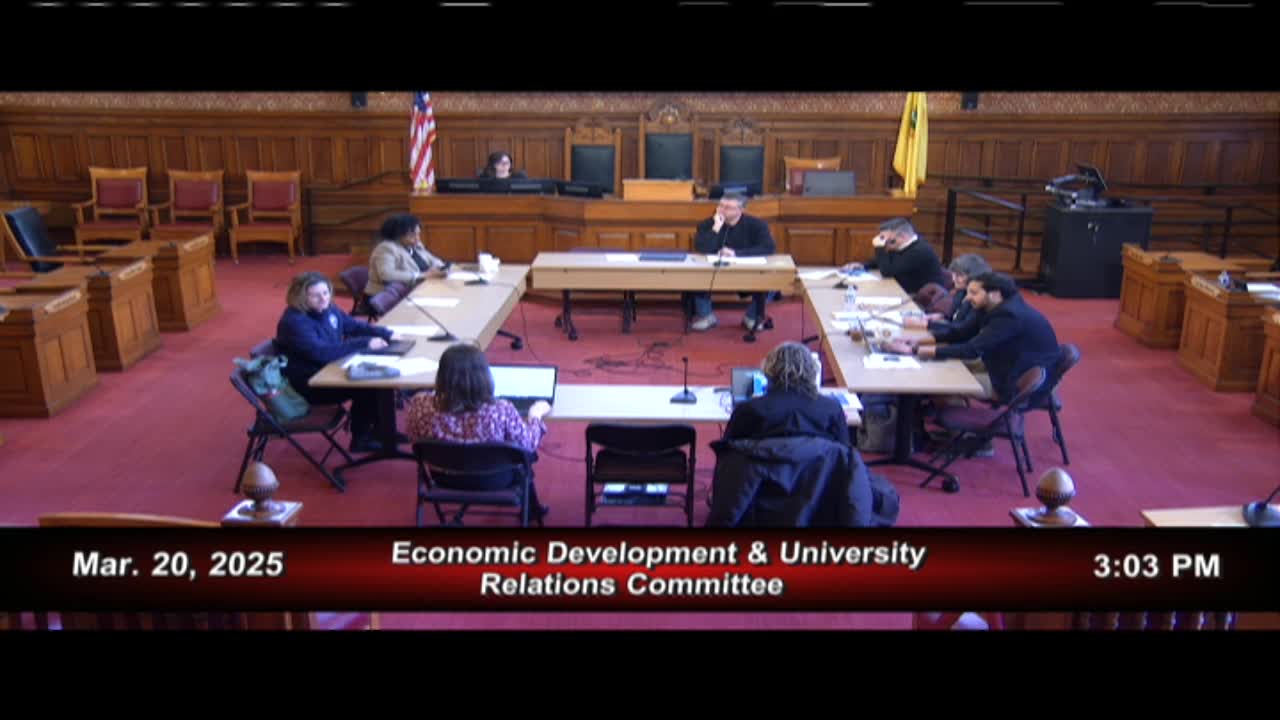
The testimony came at an Economic Development and University Relations Committee meeting called to discuss retail cannabis issues in Cambridge. Jonathan Tucker, who said he founded the Boston Garden dispensary in Cambridge, described the local market as "an unforgiving landscape" and said a new store opening 1,800 feet from his location would be "an existential threat" to his business.
"The legal cannabis industry in Cambridge and in Boston has proven to be an unforgiving landscape where even the most well intentioned businesses struggle to survive," Tucker said. "Against this backdrop, the prospect of a new store opening just 1,800 feet from our location is not just a competitive challenge. It's an existential threat to us." (Jonathan Tucker, founder, Boston Garden Dispensary)
Other operators repeated that point while urging protection for equity applicants. Michael Latulip, identifying himself as an economic empowerment priority applicant, told the committee he supported Councilor Simmons' amendment to remove the 1,800-foot buffer but asked the city to "simultaneously implement a cap on the number of marijuana retail licenses set at the current number of licensed retailers." Latulip said equity applicants had endured "significant bureaucratic hurdles" and would be disadvantaged if larger operators entered the market without similar burdens.
Sia Zamora, CEO and owner of Yamba Market in Central Square, said her business opened in February 2022 and that owners who had built the market in Cambridge deserved protection. "I support the removal of the buffer zone if and only if Cambridge affects license caps for those businesses that...have been facing 5 years of regulatory challenges," Zamora said.
City staff described how the buffer rule is codified and what it does. Christina Delicio of the Economic Opportunity and Development Division summarized that the 1,800-foot restriction lives in the city's zoning code and applies only to cannabis retail stores, not delivery or production. She explained the local ordinance and zoning work together: an ordinance defines priority applicants (economic empowerment applicants, social equity applicants, woman- and minority-owned businesses certified by the Commonwealth's supplier diversity office, and some low-income Cambridge residents), while the zoning code enforces the 1,800-foot rule with exceptions for priority applicants.
Delicio said the ordinance's priority period and the priority categories were intended to align Cambridge with state equity goals, and noted there is no grandfathering: "Even though I was there first...there is no grandfathering, and there is no...I got here first," she said in a hypothetical example describing how a newly designated economic empowerment applicant could trigger the buffer for an existing retailer.
Councilors and other speakers debated the policy tradeoffs. Vice Mayor Mark McGovern and Councilor Paul Toner emphasized the original intent to create a first-mover advantage for equity applicants; both said the city's initial rules had succeeded in preventing large multistate operators from quickly displacing local entrants. Councilor Ayesha M. Wilson and others requested more time and analysis before any policy change.
Solicitor staff told the committee that the council could impose a local cap but that, under state law, a cap set by the council could not be less than 20% of the city's off-premise retail liquor licenses unless approved by voters. Staff cited a December 2024 count of 46 off-premise retail liquor licenses, which yielded a 20% floor of nine cannabis retail licenses that the council could set without a citywide vote.
Speakers also raised the issue of owners' exit options. Several equity applicants described being constrained by the 51%/49% ownership structure that determines who triggers priority protections; owners who control 51% can sell only to others who meet the priority requirements, they said, limiting potential buyers and affecting valuations. Others described the current market pressures — including falling wholesale prices and competition from unregulated sources — that make raising capital and sustaining operations difficult.
Committee members did not vote on changes to the buffer or on a license cap. Chair Paul Toner suggested scheduling another meeting in roughly three months to continue the discussion. Councilor Wilson requested a legal opinion on whether the city could reinstate or modify any priority period that has lapsed.
Ending: No ordinance or zoning change was proposed or voted on at the meeting. Committee members and staff said they will continue studying options and that follow-up meetings and legal guidance will be scheduled so the council can consider the balance between protecting equity applicants and expanding market access.