Get Full Government Meeting Transcripts, Videos, & Alerts Forever!
Get email alerts on the Solarize Skagit topic
No spam. Unsubscribe anytime.
Solarize Skagit 2025 campaign aims for 50 home installations as net metering faces change
Summary
Skagit Valley Clean Energy Alliance presented Solarize Skagit 2025 to county commissioners on March 18, offering group-purchase pricing ($2.45/watt), preselected installers, financing options and a push to enroll before the state net-metering rules change at the end of 2025; presenters sought county help promoting enrollment.
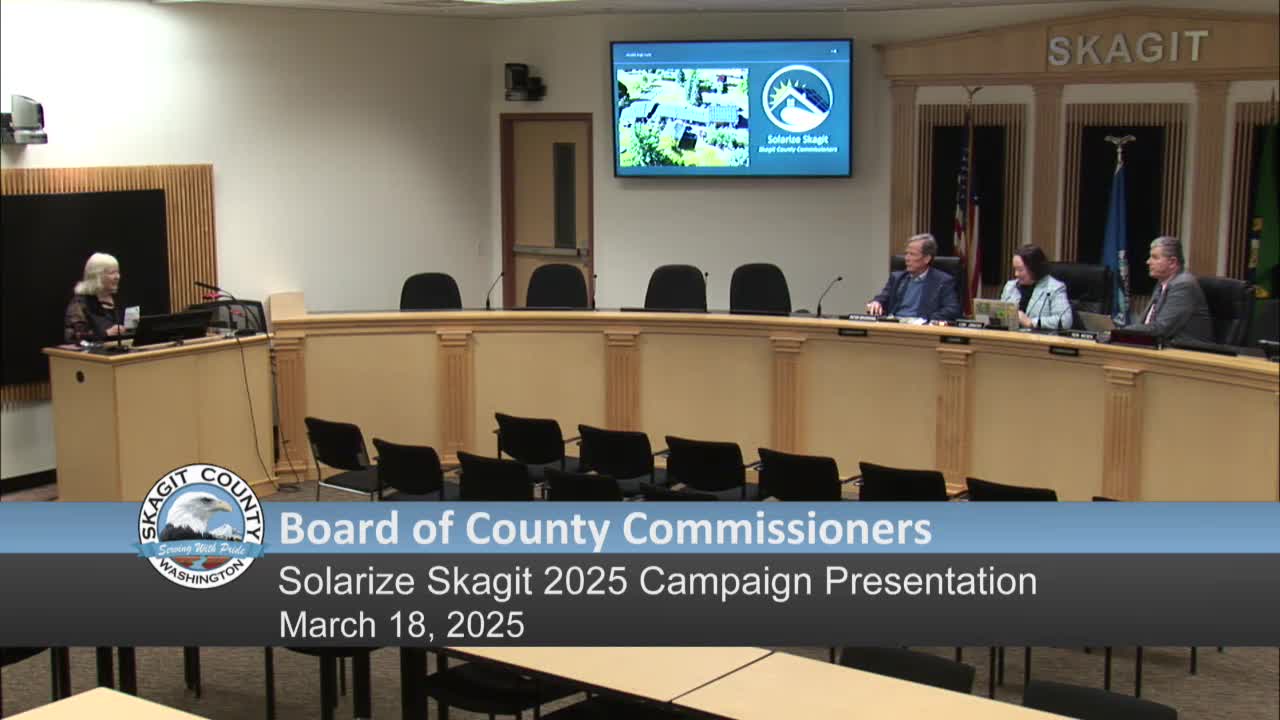
Skagit Valley Clean Energy Alliance, a local nonprofit, presented Solarize Skagit 2025 to the Skagit County Board of County Commissioners on March 18, urging residents to enroll in a limited-time group-purchase campaign for rooftop solar, battery backup and EV chargers. The campaign offers negotiated pricing ($2.45 per watt), preselected installers and financing options; the alliance’s presenters stressed that 2025 is a critical year because Washington’s 1:1 net-metering policy is set to change at the end of the year.
Why it matters: participants who enroll and install under current rules can lock in favorable net-metering treatment that credits exported solar energy at a 1:1 ratio; federal incentives (a cited 30% federal tax credit) and local procurement discounts can materially affect payback and affordability.
Mary (last name not specified), representing Skagit Valley Clean Energy Alliance, and Greg Whiting, introduced technical details and program logistics. They described Solarize Skagit as a time‑limited group-buy program run with administrative partner Olympic Community Solar (a 501(c)(3)). For 2025 the organizers negotiated a retail price of $2.45 per watt with two primary installers for Skagit County (Western Solar and Truly Electric) and partnered with Puget Sound Cooperative Credit Union to offer reduced-rate financing.
Program details presented to commissioners included: - Pricing and equipment: $2.45 per watt negotiated price; option to specify Washington-made panels (Silfab, based in Burlington) and battery backup or level‑2 EV chargers as add-ons. - Example cost: for a representative 1,700-square-foot home needing a 12 kW system, the presenter estimated a gross installed cost near $29,400 and a net cost after a 30% federal tax credit of about $20,580; the presenter said the payback in that example is roughly 12.6 years (presenter noted this is a conservative estimate). - Performance and warranties: organizers said panels typically degrade around 1% per year and that many modern installations include 25-year warranties; presenters said many panels today can produce usable power for several decades. - Enrollment and timeline: outreach and enrollment run March–July with installation through the end of the year; organizers aim to expand from 17 installations in 2024 to 50 installations in 2025.
Commissioners asked technical and program questions. Commissioner Browning asked about roof age and warranty; presenters said installer assessments include roof condition and that warranties vary by component. Commissioner Wiesen asked whether utilities and the PUD had been contacted for outreach; presenters said they had not yet contacted the PUD but would. Commissioners also asked about financing terms and battery costs; presenters said financing options were available (organizers described 20‑year financing as likely, but specific loan terms depend on the lender) and that battery costs vary by system size (examples in discussion placed battery costs in multiple-thousand-dollar ranges).
Presenters discussed the pending change to state net-metering rules, saying Washington’s net-metering policy was designed to stimulate local solar adoption and that the current 1:1 retail credit may be scaled back or replaced once policy targets are met; the presenters also summarized utilities’ perspective that net-metering credits retail value while wholesale energy cost is substantially lower.
Organizers requested county assistance to promote the campaign through jurisdiction mailers, newsletters and community events; they also described an April 12 kickoff in La Conner and planned outreach at farmers’ markets.
Ending: presenters requested commissioner support for outreach and community promotion, and commissioners expressed interest in helping with publicity. No county action or funding decision was made at the meeting.