Get Full Government Meeting Transcripts, Videos, & Alerts Forever!
Get email alerts on the House Bill 443 topic
No spam. Unsubscribe anytime.
House Bill 443 forces rewrite of Lexington development review; staff racing to adopt objective standards ahead of July 1 deadline
Summary
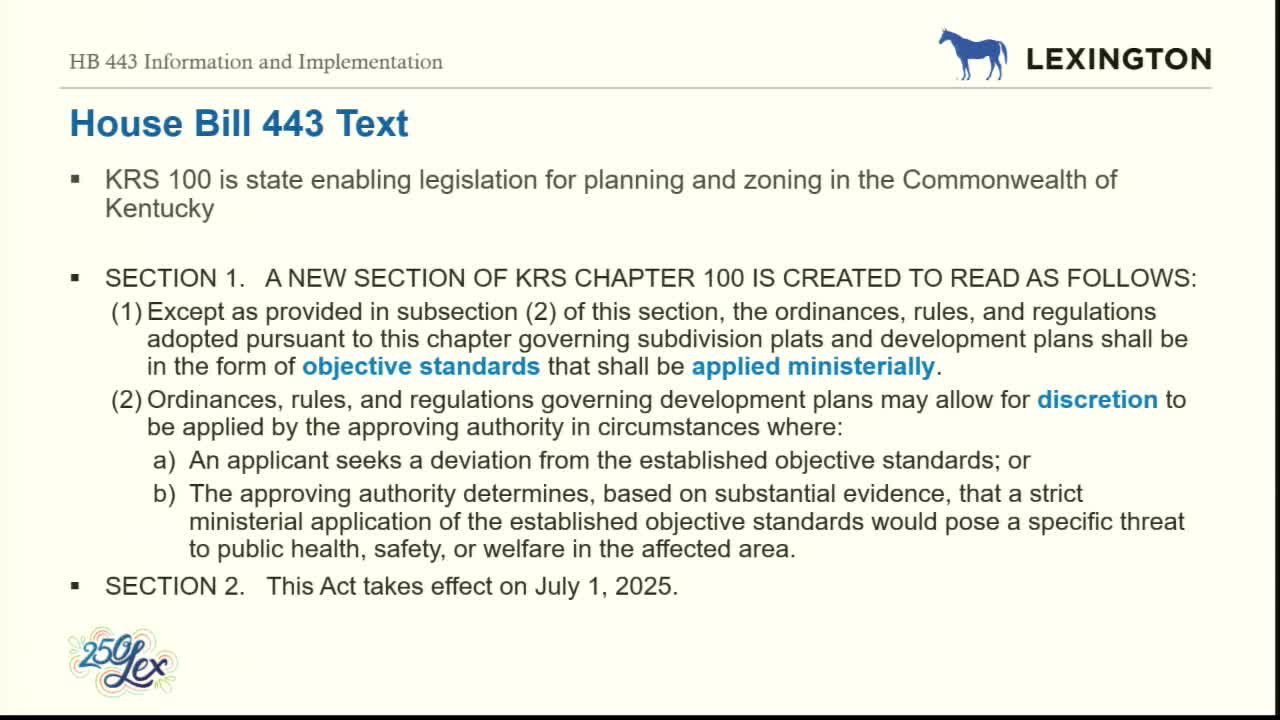
Planning staff and the city attorney told the Planning Commission on March 17 that House Bill 443 requires jurisdictions to apply objective standards ministerially for many development‑plan reviews, prompting a citywide zoning text amendment to avoid gaps when the law takes effect on July 1, 2025.
Planning staff and the city attorney told the Planning Commission on March 17 that House Bill 443 requires jurisdictions to apply objective standards ministerially for many development‑plan reviews, prompting a citywide zoning text amendment to avoid gaps when the law takes effect on July 1, 2025.
Daniel Crum, a planning staff member, described the legislative change as a requirement to translate informal practices and division-level sign‑offs into written objective standards so development plans that meet those standards can be approved without discretionary review. "House Bill 443 relates to how we review our plats and development plans and requires those to be objectively measured and applied ministerially," Crum said.
Crum told commissioners staff is updating the zoning ordinance in three main categories: process changes to reflect a larger role for the Technical Review Committee (TRC); conversion of subjective or administrative sign‑offs into objective, codified standards; and adoption of certain technical standards the city has applied in practice (for example, access management and pedestrian circulation rules) so they remain enforceable under the new statute. He said staff will remove provisions that fall outside the immediate scope of the statute and will track some topics on a separate timeline.
Tracy Jones, the city attorney, told the panel that the statute is specific: objective standards applied ministerially leave little room for discretionary public hearings on routine development plans. She said the city must comply with the statute because local zoning authority is granted by state law.
Commissioners raised concerns about reduced opportunities for public input on development plans and asked for training. Several members requested staff provide orientation and case examples before the law takes effect so the commission can identify what is within its authority to influence. Crum and Jones said staff will provide briefings and case examples; staff offered to meet with commissioners in small groups.
Crum reported staff aims to circulate a revised draft the week of March 24 (he said a draft was expected to be available Monday or Tuesday following the March 17 meeting) and to present the text at the Planning Commission meeting on March 27, followed by Urban County Council consideration. He said the city needs to have adopted objective standards in place before July 1 to avoid a regulatory gap.
Crum: "Most of what the updated draft is gonna be ... is going to be taking away, not adding. So you have the bulk of what's going to be presented at the public hearing on Thursday already." Jones added that while the change will be difficult for the public and commission accustomed to discretionary review, staff is attempting to codify longstanding technical practices into objective rules.
Commissioners asked for training and for staff to clarify the waiver process (the statute allows waivers in certain circumstances). Staff said they will prepare a primer and schedule orientation sessions and will provide the revised draft to commissioners as soon as it is ready.