Get Full Government Meeting Transcripts, Videos, & Alerts Forever!
Get email alerts on the Hampton Clarendon topic
No spam. Unsubscribe anytime.
Hampton–Clarendon Corridor authorized hearing set for more review after heated public comment
Summary
The City Plan Commission held the authorized hearing on the Hampton–Clarendon Corridor (West Oak Cliff) but agreed to keep the record open and revisit the item on April 24 after strong public turnout and concerns about displacement, small-business impacts and infrastructure.
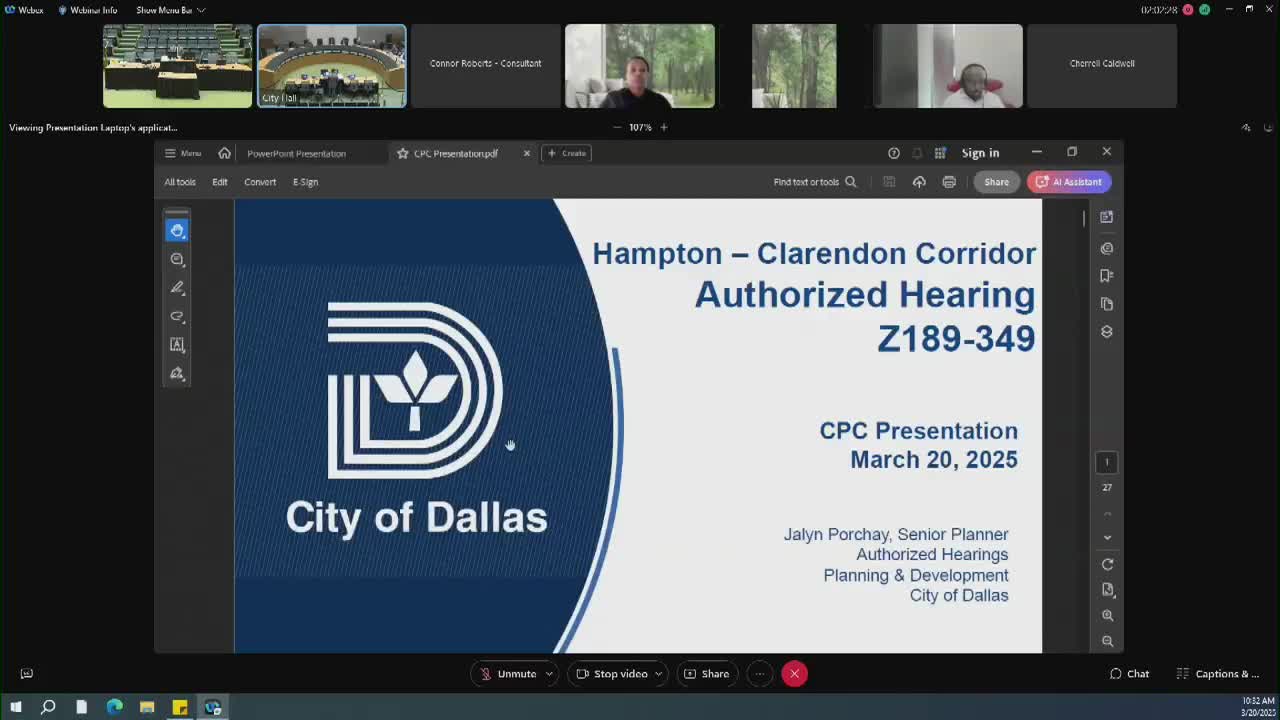
The Dallas City Plan Commission heard staff’s proposal for the Hampton–Clarendon Corridor — a walkable urban mixed-use (WMU 3) form district with a targeted shop‑front overlay at the Hampton/Clarendon intersection — and voted to hold the public hearing open and continue deliberation to April 24.
Staff recommendation and rationale: City staff presented the authorized-hearing package as the implementation step for recommendations in the West Oak Cliff Area Plan (adopted October 26, 2022). Staff recommended WMU 3 with a limited shop‑front overlay on the corner of Hampton and Clarendon to promote pedestrian-oriented, small-scale mixed-use buildings, narrow front setbacks, rear parking, and reduced maximum height (from 54 feet to 50 feet, 3½ stories) while retaining the residential proximity slope (RPS) to protect adjoining single-family neighborhoods.
Public testimony and neighborhood concerns: More than a dozen residents and business owners spoke at the hearing. Common themes: - Small-business vulnerability: auto service shops and long-standing Latino-owned retail operators said rezoning to allow residential uses risks displacement and higher land values that will make it difficult for legacy businesses to survive. - Affordable housing vs. displacement: Several speakers supported more housing but argued the plan must include concrete measures (land acquisition, affordability programs or protective overlays) to keep existing residents and businesses in place. - Infrastructure and environmental concerns: Some residents raised stormwater, drainage and contaminated soils issues near older industrial lots that must be studied and addressed before major redevelopment. - Outreach and trust: Multiple speakers said neighborhood organizations and some community leaders felt the outreach and follow-up had not fully resolved concerns; several asked for additional time to reach consensus and suggested a delay.
Staff reply and key points - Planner Jalen Porsche reiterated that WMU 3 is the lowest-intensity walkable mixed‑use form district and that the proposed RPS and other standards are intended to limit tall redevelopment immediately adjacent to single-family neighborhoods. "Staff's recommendation is walkable urban mixed use form district, which is WMU 3," Porsche said during his presentation. - Staff noted SB 2023-era notice requirements (e.g., SB 929 notifications to affected parcels) had been sent to potentially impacted properties when uses would become nonconforming under the proposal.
Outcome: The commission voted to hold the public hearing open and continue the authorized hearing to April 24 to allow additional time for neighborhood leaders and property owners to finalize voluntary agreements and to let staff incorporate clarifications requested by commissioners.
What happens next: Staff will reopen the record on April 24 for additional public input and revised materials. The authorized-hearing process will produce a text amendment and map recommendation that the commission can later forward to City Council; Council would make the final zoning decisions on any text/map changes.