Get Full Government Meeting Transcripts, Videos, & Alerts Forever!
Get email alerts on the School Nutrition Special Diets topic
No spam. Unsubscribe anytime.
TDOE trains school nutrition staff on accommodating students with disabilities in meal programs
Summary
At a virtual Tennessee Department of Education training, staff reviewed procedural safeguards, medical-statement requirements, allergy and gluten guidance, funding responsibilities and coordination with IEP/Section 504 teams for meal modifications to support students with disabilities.
The Tennessee Department of Education held a virtual training (date: not specified) for school nutrition staff on accommodating students with disabilities in school meal programs, covering procedural safeguards, required medical statements, allergy management and funding responsibilities.
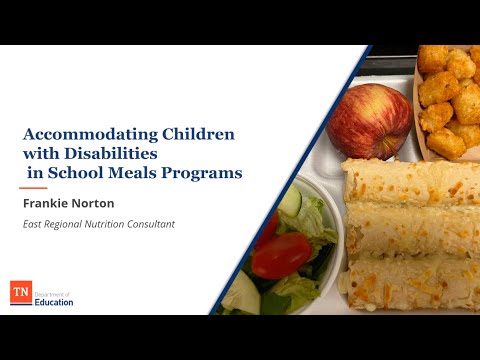
Frankie Norton, East Region School Nutrition consultant, opened the substantive portion saying, “We're gonna learn about special diets or, as you see on the screen, accommodating children with disabilities in school nutrition programs.” The session asked districts to review written procedures, use a team approach that includes their 504 coordinator, school nurse and nutrition supervisor, and to document timelines for temporary accommodations.
Norton and trainers emphasized federal legal and policy touchpoints. They noted obligations under the Americans with Disabilities Act and coordination with Individualized Education Programs (IEPs) and Section 504 plans. Norton said medical documentation is required when a requested accommodation would alter the USDA meal pattern: “anytime if you get if you get a request for a meal modification, if the meal pattern must be altered in order to meet the modification, then it's gonna require a medical statement.”
The training listed required elements of a medical statement: a description of the impairment and how it restricts the child's diet, an explanation of how to accommodate the condition, and specific foods to omit and suitable substitutions. Norton advised staff to make as much of an accommodation as is safely possible while promptly seeking clarification from the parent when a medical statement is unclear. The session also advised against school nutrition staff contacting medical providers directly.
Trainers highlighted a change tied to a recent federal rule: “registered dietitians and registered dietitian nutritionists are now on the list when they were not before,” Norton said, noting acceptance of dietitian-signed medical statements becomes required on July 1, 2025. The presenters suggested districts may find registered dietitians helpful when labels or ingredient lists are hard to interpret.
On food allergies and gluten, the training reviewed common allergens and cautioned that some ingredients and processed foods can contain “hidden” gluten (for example, malt or hydrolyzed plant protein). Norton recommended working with vendors and manufacturers and involving parents when appropriate. For seating or “allergy-safe” spaces, trainers said such arrangements must be voluntary and decided case by case with family input.
Regarding cost and funding, the presenters said the cost of required accommodations may not be charged to students or families: “the cost cannot be charged to this student or the parent.” They explained that LEA general funds, the food service fund, or, in some cases, special education funds may cover accommodations; items or services outside normal meal service that are specified in an IEP or 504 plan are the LEA’s responsibility.
The training clarified distinctions between medical needs and food preferences (religious, vegetarian, or lifestyle requests). If a district chooses to provide a non-disability preference, it must meet USDA meal-pattern requirements and be offered consistently to all who request it. Presenters warned that Offer Versus Serve cannot be used to deny a required meal component for a student with a documented medical need unless an approved substitution is specified.
Trainers closed by urging districts to formalize procedures: create clear submission processes for meal-modification requests, assign team members at each school, specify timelines for temporary accommodations, and publicize the process to families. Materials and the slide deck are available through the TeachAll platform and via regional consultants.
For questions, Norton and the TDOE training staff directed participants to contact their regional consultant for follow-up and sample forms.