Get Full Government Meeting Transcripts, Videos, & Alerts Forever!
Get email alerts on the Truck Parking Policy topic
No spam. Unsubscribe anytime.
Council approves ordinance to restrict overnight oversized‑vehicle parking near residences, sets $500 fine
Summary
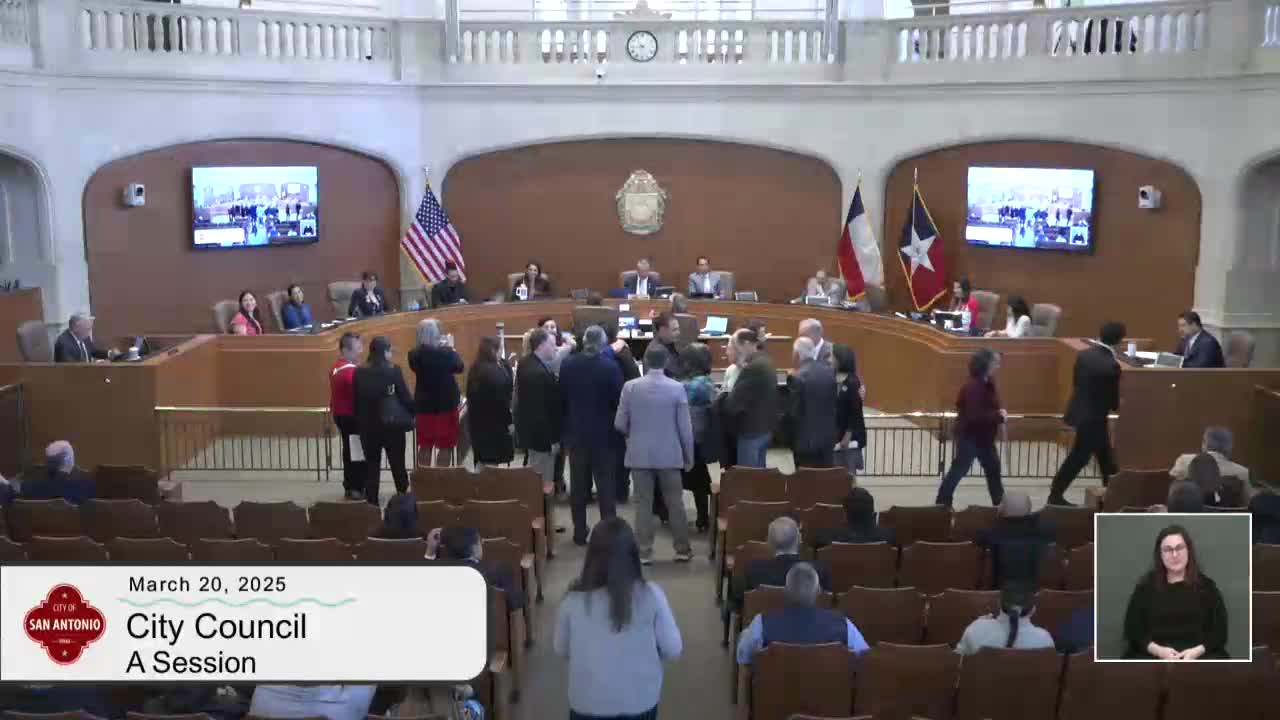
The City Council approved an ordinance March 20 restricting overnight parking of truck tractors and semi‑trailers within 1,000 feet of residentially zoned areas between midnight and 6 a.m., with a $500 fine and a staged enforcement plan tied to resident 311 requests.
San Antonio — The City Council on March 20 approved an ordinance restricting the overnight parking of certain oversized vehicles near residences and establishing a $500 fine for violations, a change city staff described as a step to address safety and quality‑of‑life concerns in neighborhoods.
Under the council action (item 16), the amended measure focuses on truck tractors and semi‑trailers and applies the restriction within a 1,000‑foot buffer of residentially zoned areas between midnight and 6 a.m., except when a vehicle is actively loading or unloading or making emergency repairs. The council approved a staff‑recommended, amended implementation process that relies on resident requests through the city’s 311 system to trigger targeted signage and local evaluations.
Maria Vargas, director of the Integrated Community Safety Office, told the council the ordinance responds to two council consideration requests and extended public outreach, including virtual town halls and a survey. Vargas summarized the enforcement and implementation timeline: warnings during the first 60 days after the ordinance’s effective date, citations beginning 90 days after effectiveness, focused signage on streets with the highest violation rates and a GIS search tool on the city website so truck drivers and residents can check whether a location falls inside the restricted buffer.
The council also directed outreach to the Texas Department of Transportation to request a district‑level truck parking study and said city staff would distribute educational materials to truck stops, training facilities and trucking associations.
Public speakers described neighborhood hazards and enforcement challenges. David Fritsch, an attorney and North Side property owner, urged the council to treat the issue as after‑hours vehicle storage, not temporary parking. He described a January nighttime crash in which a parked tractor‑trailer was involved and said, “parking is not what I'm seeing — these vehicles are being stored on public rights of way,” noting blocked sight lines near medical facilities and day‑care centers.
John Wood, president of the Oakland Heights homeowners association, told the council 18‑wheelers have created safety risks on commuter routes and obstructed emergency access. “Cars have to swerve around these 18 wheelers into opposing lanes,” he said, and described prior efforts to work with businesses to remove truck parking from sidewalks and travel lanes.
Councilmembers said the ordinance balances the interests of truck drivers and residents. Councilmember Villagran moved an amendment to select targeted enforcement (option B in staff materials) that requires a resident 311 request and staff evaluation before signs are installed; the council adopted that amendment and then passed the ordinance as amended. The council did not publish a roll‑call tally in the transcript; the mayor announced the motion carried.
Councilmembers also raised implementation concerns: the public‑works engineering assessment for a 311 request has a service‑level target of 30 days, a separate 30‑day work order covers sign fabrication and installation, and staff warned residents the overall process could take several weeks. Staff said the San Antonio Police Department’s SAFE officers will lead initial educational enforcement and then coordinate citations; for daytime restrictions code compliance can also enforce when applicable.
Councilmembers asked staff to monitor 311 response times and consider enforcement resourcing; some members recommended budget consideration for additional code officers. The ordinance sets the fine at $500 to align with existing oversized‑vehicle penalties in residential zones and directs signage and public education as part of rollout.
The ordinance is effective 30 days after council approval; the transcript records warnings during the first 60 days and citation issuance beginning 90 days after the effective date.