Get Full Government Meeting Transcripts, Videos, & Alerts Forever!
Get email alerts on the Inspector General Office topic
No spam. Unsubscribe anytime.
Committee adopts amendment to bill creating independent inspector general for Minnesota programs
Summary
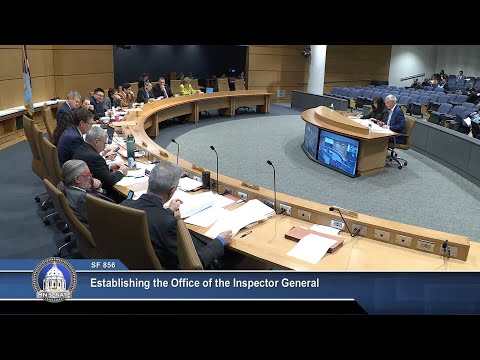
The Senate State and Local Government Committee on March 20 adopted an A43 amendment to Senate File 856, a bill that would create an independent Office of Inspector General to increase oversight of public funds in Minnesota, sponsor Senator Gustafson told the committee.
The Senate State and Local Government Committee on March 20 adopted an A43 amendment to Senate File 856, a bill that would create an independent Office of Inspector General to increase oversight of public funds in Minnesota, sponsor Senator Gustafson told the committee.
The amendment, adopted by voice vote, and the bill’s sponsors aim to clarify the new office’s jurisdiction, strengthen collaboration with existing state agencies and preserve agency responsibilities while giving the OIG authority to investigate suspected fraud, Senator Gustafson said.
Senator Gustafson, the bill’s presenter, told the committee that Senate File 856 "establishes the independent office of inspector general. It enhances accountability, transparency, and oversight of public funds in Minnesota." She said stakeholders including Minnesota Management and Budget (MMB), the Department of Human Services (DHS), the Department of Children, Youth, and Families (DCYF) and the Office of the Legislative Auditor (OLA) had been engaged in drafting changes.
The A43 amendment makes several substantive changes, sponsors said. It explicitly authorizes the OLA to coordinate with the OIG on reviews and investigations; it adds current and former governors and legislators to a list of people who cannot be appointed inspector general; it requires a hearing by a legislative inspector general advisory commission before removal in the circumstance described in the amendment text; and it narrows language to focus the OIG’s authority on fraud and misuse, sponsors said. Senator Gustafson summarized the amendment section by section for committee members.
The amendment also gives the OIG an option, when fraud is suspected and an emergency exists, to seek a court order to stop distribution of money or to alert an agency on an emergency basis and to notify appropriate law enforcement, sponsors said. The amendment lists program areas where the OIG may investigate in certain circumstances, including DHS Medicaid fraud investigations, DCYF's Child Care Assistance Program, and Department of Health programs such as WIC and Food Support programs, according to sponsor remarks.
Committee members asked detailed questions about how the OIG would work alongside existing investigatory authorities. Senator McQuaid raised independence concerns and asked whether the amendment’s bar on appointing former candidates or officeholders (lines 1.5–1.6 of the amendment) might still allow people who previously ran for office to be considered. Senator Gustafson said the language aims to protect independence and that the commission selecting finalists would include bipartisan legislative representation.
Members also asked whether departments would be required to refer internal investigations to the OIG. Senator Gustafson said departments such as DHS would continue to have primary responsibility for investigating Medicaid fraud and could refer matters to the attorney general; the OIG would have access to those investigations and could independently investigate when necessary, but departments are not required by the bill to refer all matters to the OIG.
The bill’s text includes data-practices provisions to permit the OIG access to necessary data (sponsor cited line 7.25), and it directs the OIG to refer matters for civil, criminal or administrative action to the Bureau of Criminal Apprehension (BCA), the attorney general’s office or other appropriate authorities (sponsor cited lines 5.8–5.9).
Senator Croon, a co-presenter, described the legislation as "a big bill" and said sponsors had met with many stakeholders and made changes in response to feedback. Multiple senators commended the sponsors for continued stakeholder work and for trying to reduce overlapping investigations between agencies and to clarify each agency’s primary responsibilities.
Committee members suggested additional ideas not included in the amendment, such as requiring agencies to provide an obvious link for public tips to the OIG on their websites and considering a state-level "do-not-pay" or exclusion list similar to existing federal lists; those suggestions were discussed as potential future refinements rather than included language.
The committee adopted the A43 amendment by voice vote. No final committee vote on Senate File 856 was recorded during this hearing; sponsors said the bill remained a work in progress and would go through further meetings and committee stops.
Senator Gustafson said the sponsors will continue meetings with agencies and stakeholders as the bill moves forward.