Get Full Government Meeting Transcripts, Videos, & Alerts Forever!
Get email alerts on the Permanent Navigation Center Modular topic
No spam. Unsubscribe anytime.
Committee weighs modular interim housing and 200 Michigan site; mayor urges larger purchase near jobs
Summary
City staff summarized visits to modular interim housing projects and recommended using city‑owned 200 Michigan Ave for a modular interim shelter, while some members urged exploring a larger purchase near jobs in the business park.
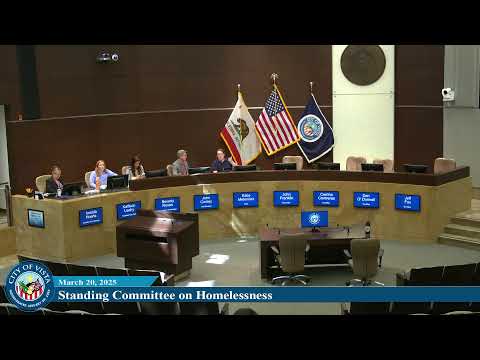
City staff returned to the standing committee with a review of modular interim housing options, site choices and preliminary cost estimates for a permanent city‑owned interim housing facility.
“After reviewing other proposals for adaptive reuse of established buildings, staff recommends the utilization of a city owned property at 200 Michigan Ave for partial demolition, reconstruction, and renovation,” Daniel Stearman, the city management analyst, told the committee as he summarized site work and construction estimates.
Why it matters: Vista has allocated capital toward a permanent interim housing facility and must decide whether to adapt the Lifeline‑operated city parcel at 200 Michigan Avenue, build modular units on other city land or pursue purchase/rehabilitation of a larger commercial property in the business park. Committee members balanced faster modular deployment against long‑term property ownership and cost.
What staff presented - Field visits: Staff and elected officials visited two existing modular projects: Victorville Wellness Center (Connect Homes prefab modules; a Homekey Round 2 project reported at roughly $28 million total, including $23 million for construction) and the Azusa Resource Center (LifeArc/Leichvarck model; reported construction ~$1.95 million). - Unit costs and proposals: Staff shared rough orders of magnitude for three modular approaches for Vista’s site: a stick‑built mobile modular estimate of about $3.6 million (~$75,000 per bed), a LifeArc recycled‑plastic modular proposal ~ $3.8 million (~$79,000 per bed), and a broader ShelterPro/Infinite Structures steel‑frame modular estimate (very preliminary) of $5.5 million–$8 million. - Site recommendation: Staff proposed reusing the city‑owned two‑acre parcel at 200 Michigan Ave (current Lifeline operations) and demolishing some older buildings to make space for modular shelter buildings, administrative space and a kitchen/dining building already present on the site.
Committee debate and alternatives Some committee members supported modular units as a rapid way to provide dignified, non‑congregate sleeping rooms and services; others urged a broader look at buying and renovating a larger commercial building in the city’s business park to house shelter, job‑training space and consolidated nonprofit offices.
Mayor (commenting on alternatives) suggested a larger strategy: “What if we bought a 30,000 square foot facility for between 7 and $10,000,000?” He argued a larger purchase near the Business Park could colocate services and connect residents to 27,000 local jobs. Several members pushed back that available properties in the business park carry high purchase prices and noted time constraints; staff said purchase prices and sale listings had been reviewed but many options were cost prohibitive.
Staff noted tradeoffs - Time vs. permanence: Modular units can be sited and activated faster and can be placed on temporary or permanent foundations; stick‑built modular and recycled‑plastic units were presented as options with different lifespans and installation profiles. - Kitchens and services: The 200 Michigan parcel already contains a kitchen and meeting/dining space, a feature several committee members said is important for nutrition and program operations. - Cost/financing constraints: Committee members reviewed city capital already allocated ($4.5 million previous allocation and other state grants noted by staff) and acknowledged that larger purchases would require assembling additional funding from state grants and partners.
Next steps and staff request Staff said proposals and rough orders of magnitude will be presented to council (the item was scheduled for April 8) and asked for committee direction on whether to: move forward with modular construction on the city parcel, pursue purchase and rehab of an external property, or return with more detailed cost comparisons and funding scenarios. Several members asked staff to present a clearer side‑by‑side cost comparison (purchase + rehab versus modular build) and to identify possible additional funding sources and timelines.
Ending The committee did not select a single approach at the meeting. Staff will refine construction cost estimates, clarify funding sources and return with more detailed comparisons and schedule options for the full council.