Get Full Government Meeting Transcripts, Videos, & Alerts Forever!
Get email alerts on the Fraud Prevention Package topic
No spam. Unsubscribe anytime.
Committee hears governor's fraud-prevention package that includes AI pilot, new enforcement tools and tougher penalties
Summary
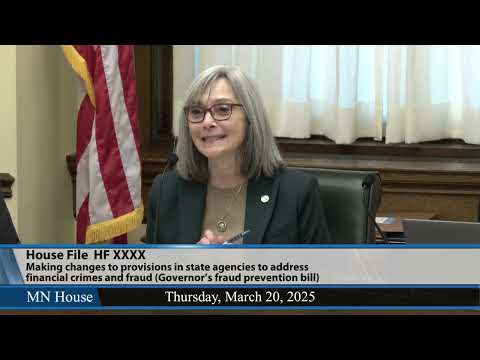
The State Government Finance and Policy Committee convened an informational hearing March 20, 2025 to review the governor's proposed fraud-prevention package.
The State Government Finance and Policy Committee convened an informational hearing March 20, 2025 to review the governor's proposed fraud-prevention package. House author Representative Lindsey Pinto said the package "builds on work that we've done in past years" and that some provisions are moving as separate bills (Representative Elkins is carrying the data-sharing portion, House File 2429; Representative Pinto said she is carrying House File 2370 on payment-withhold authority).
The package is organized around three goals: stronger investigative and enforcement authority, better detection and oversight, and increased criminal penalties. Erin Campbell, Commissioner of Minnesota Management and Budget (MMB), told the committee the state intends to use a mix of executive, budget and statutory changes to equip agencies to detect and stop fraud and to hold offenders accountable. "Fraud against these public programs is unacceptable. It's not a victimless crime and it harms the same people that we're trying to help with these services," Campbell said.
Nut graf: Agency witnesses described investments and policy changes that would affect Medicaid and other state-administered programs, charter school oversight, grant administration and licensing for select provider types. Key proposals include an AI pilot to identify Medicaid payment anomalies in real time, expanded interagency data sharing, authority for agencies to temporarily stop payments when credible allegations exist, creation of a distinct theft-of-government-funds statute with higher penalties, and added investigative capacity across the BCA, Attorney General's office and agency inspector general offices.
Most important details - Detection and data tools: Tarek Tombs, commissioner of Minnesota IT Services (MNIT), described a planned pilot to use artificial intelligence and machine-learning tools to flag anomalies for Medicaid providers and to build enterprise data-warehouse capabilities so agencies can cross-check income, benefits and other records. "This proposal represents a significant advancement of proactive data driven fraud prevention," Tombs said. He told the committee procurement of technology would go through MNIT and that the request budgeted for a pilot but no specific vendor had been selected.
- Investigative workforce and structure: Drew Evans, superintendent at the Minnesota Bureau of Criminal Apprehension (BCA), testified that the administration combined the BCA Financial Crimes Section and the Commerce Fraud Bureau into a single Financial Crimes and Fraud Section earlier in 2025 and that the governor's budget would add two attorneys general and one forensic accountant to that unit to support complex cases and Greater Minnesota county attorneys. Evans said a separate proposed statute would place theft of government funds in its own statutory section and increase penalties.
- Department of Human Services (DHS) proposals: Shereen Gandhi, temporary commissioner for DHS, described program-integrity challenges and specific proposals. DHS oversees roughly 390,000 providers (142 of those are entities), Gandhi said; over the last five years DHS staff conducted about 4,000 investigations, stopped payments to about 600 providers, referred more than 400 cases to law enforcement and recovered roughly $18,000,000 per year on average. DHS proposals mentioned in testimony include: expanding data-sharing authority to act on investigative information more quickly; the authority to disqualify individuals under active fraud investigation from ownership/controlling roles; provisional licensure for certain autism/EIDBI providers to enable faster action to protect children and families; and statutory alignment to prevent double-billing for overlapping time-based claims. Gandhi also described funding for prepayment reviews (contracted reviews of selected claims) and using AI analytics in partnership with MNIT to analyze large claims data sets.
- Child care attendance and DCYF: Tiki Brown, commissioner of the Department of Children, Youth and Families (DCYF), proposed $5.4 million in FY26-27 and $2.8 million in FY28-29 for program-integrity work (two FTEs) and proposed requiring electronic attendance and enrollment recordkeeping for the Child Care Assistance Program (CCAP), a step the agency said responds to a 2019 legislative auditor recommendation.
- Department of Education (MDE) OIG and charter oversight: Willie Jett, education commissioner, proposed $550,000 annually to add three FTEs and software to strengthen the department's Office of Inspector General, one investigator, two legal counsels focused on nutrition and charter school oversight, and improved authority for audits, records access and sanctions for charter schools and nutrition programs.
- Grants and debarment: Tamara Gronvall, Department of Administration commissioner, described a proposal to expand the definition of "grantee" so the Office of Grants Management can suspend or debar potential grantees (entities not yet awarded funds) for debarment-worthy causes (embezzlement, theft, bribery, falsification of records and similar convictions), and to require state employees to report suspected grant-law violations.
Questions from lawmakers and concerns Committee members pressed on timing, costs and whether requiring employees to report suspected fraud simply restates existing expectations. Representative Paul Kosnick questioned the timing and size of requested investments and urged that reporting responsibilities already should be standard practice. Commissioner Campbell and other commissioners replied that agencies need additional staff and technical resources to match the scale and sophistication of recent schemes and that annual training and no-retaliation protections apply to state employees. Representative Joyce Quam pressed for a shared, centralized mechanism to flag entities suspected of fraud so agencies can cross-check potential bad actors; witnesses said statutory limits have impeded sharing and that the proposal would expand sharing authority to allow earlier action, including temporary payment withholds. Representative Matt Bonner urged urgency on data sharing and praised the AI proposal as a necessary modernization.
Implementation and next steps Witnesses emphasized that several provisions are already in separate, moving bills (Representative Elkins was identified as carrying House File 2429 on data sharing; Representative Pinto said she is carrying House File 2370 on payment-withhold authority). The committee treated the session as informational; Chair Pinto closed the hearing and the committee did not take a formal vote to lay over a single omnibus bill at this hearing. "As this was an informational hearing there is no bill to lay over at this time," a committee chair said at adjournment.
Ending: The hearing collected detailed technical and budget requests that the agencies said are necessary to expand program-integrity work statewide. Agency witnesses made several quantifiable requests and offered follow-up briefings; lawmakers signaled support for data-sharing and detection tools but pressed for clearer deployment plans and cost estimates before formal committee action.