Get Full Government Meeting Transcripts, Videos, & Alerts Forever!
Get email alerts on the Encampment Resolution Erf3 Rental Assistance topic
No spam. Unsubscribe anytime.
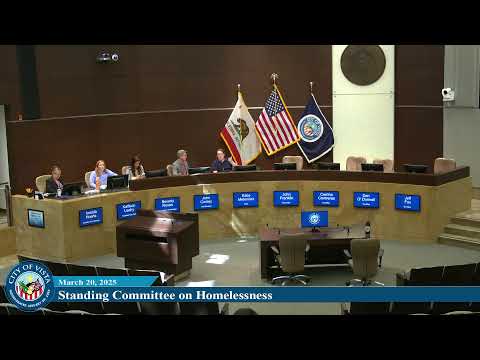
Vista committee reviews $7.8 million ERF‑3 award, debates landlord incentives and rental‑assistance design
Summary
Vista’s standing committee on homelessness reviewed the city’s awarded Encampment Resolution Funding Round 3 (ERF‑3) grant and debated how to program $2.5 million in rapid‑rehousing funds and smaller landlord incentives.
Vista’s standing committee on homelessness reviewed the city’s awarded Encampment Resolution Funding Round 3 (ERF‑3) grant and debated how to program $2.5 million in rapid‑rehousing funds and smaller landlord incentives.
“This item provides an overview of the city's approved encampment resolution funding round 3 or ERF 3 grant program,” staff member Jonathan told the committee, walking members through the application history and award timeline.
The city applied for ERF‑3 on June 25, 2024, with a total project cost in the application of $7,800,942.09. The California Interagency Council on Homelessness announced availability of ERF‑3 funds in late 2023 and Vista’s proposal scored second highest among 57 awarded proposals. The city received formal notice of award on Dec. 23, 2024, and city council later authorized the city manager to sign grant documents on Feb. 11, 2025. The council accepted and appropriated the funds on March 11, 2025.
Why it matters: the ERF‑3 award expands Vista’s homeless‑services budget for staff, outreach, rapid rehousing and pilot programs tied to a roughly 10‑mile corridor along State Route 78. Committee members said they will use their oversight role to press staff for program design that serves the greatest number of people and avoids what one member called “money up in smoke.”
What the award pays for - Staffing and administrative costs: The grant covers $925,053.08 in internal costs, including funding for existing homeless‑services positions through Dec. 31, 2026, and a limited‑term housing specialist position budgeted at $386,641 (anticipated for two years, July 1, 2025–June 30, 2027). Indirect administrative costs of $371,473 were also included. - Outreach and contracts: The ERF‑3 outreach RFP drew five proposals. San Diego Rescue Mission (SDRM) received the top score; staff said final contract award is contingent on a four‑month review of SDRM’s current agreement and a council action scheduled for March 25, 2025. - Operating and program costs: The staff presentation listed $4,180,889.01 in operating costs for strategic plan activities funded by ERF‑3, and $2,671,345 approved for operating costs tied to the outreach program procurement. - Housing and client assistance: Staff said the ERF‑3 budget includes $2,695,000 for housing and client assistance. That packet includes a $2,500,000 rapid‑rehousing allocation (budgeted to serve up to 125 households in the grant spreadsheet) and smaller items such as family‑reunification funds and workforce development ($5,000 listed). - Safe parking and navigation center reserves: The grant continues existing safe‑parking and navigation center reserves; staff reported $1,121,132 for the VISTA safe‑parking program and $388,412 for operating reserves for the Buena Creek Navigation Center (BCNC) through the program’s life.
Landlord incentives and a correction to the slides Committee members extensively questioned the $200 landlord incentive shown on the slide. Multiple speakers criticized that amount as unlikely to change a landlord’s decision to rent to someone with housing‑instability flags.
Jonathan corrected a slide during the meeting: “One error on this slide and I apologize for it's $200 per individual and not per household.” He and other staff explained that the $200 payment is one part of a broader package that also includes direct rental assistance and security‑deposit funds.
Program design issues the committee raised Committee members asked staff to return with clearer program rules and recommended changes before the council adopts contracts. Common themes: - Require case management: Committee members asked that housing assistance be administered only when a client is engaged with case management; staff said awardees would be enrolled through outreach case managers. - Prioritize below‑market and shared/programmed housing: Members recommended prioritizing lower‑cost options (shared rooms, programmatic housing with onsite support) rather than market‑rate one‑bedroom units. - Set clearer ceilings and stepped-down assistance: Members urged limits on per‑participant awards and suggested tiered or stepped‑down rental assistance rather than a fixed $20,000 cap in every case. Staff said $20,000 was a budgeting metric and not an automatic award; staff currently expect to make assistance flexible and case‑by‑case. - Monitoring and benchmarks: The committee requested program benchmarks to measure housing specialist outcomes and to require quarterly reporting on unspent reserves and program impacts. - Outreach to landlords: Members recommended allocating some housing‑specialist time or a small marketing budget to recruit and educate landlords about program safeguards and direct payments to housing providers.
Staff framing and legal limits Staff repeatedly noted that some features are constrained by grant award language and state procedures but said many implementation details—eligibility criteria, ceilings, and prioritization—are still within the city's discretion and can be shaped before contracts are final.
Actions and next steps - Historical/recorded council actions referenced in the presentation: City council approved the ERF‑3 application (June 25, 2024), authorized the city manager to sign ERF‑3 documents (Feb. 11, 2025), and accepted and appropriated ERF‑3 funds (March 11, 2025). These are recorded actions by the council; the committee meeting discussed implementation rather than taking a formal vote to change the award. - Outreach contract: Staff reported SDRM scored highest on the ERF‑3 outreach RFP; a conditional award and contract are pending a four‑month review and upcoming council action (March 25, 2025). - Committee direction: The committee provided program guidance—case management requirement, prioritization of below‑market and shared housing, marketing for landlord recruitment—and asked staff to return with draft program guidelines and contract language prior to final council action.
What remains unresolved The committee did not adopt binding changes at the meeting. Several open items remain for council or staff to resolve: the final contract recommendation for the outreach provider, exact per‑client award ceilings, AMI (area‑median income) thresholds for rental‑assistance eligibility and the amount to set aside for landlord outreach and marketing.
Ending The committee asked staff to bring more detailed program guidelines and implementation materials back to the standing committee and to the full council for review before finalizing contracts and disbursing the majority of ERF‑3 housing assistance funds.