Get Full Government Meeting Transcripts, Videos, & Alerts Forever!
Get email alerts on the State Legislation topic
No spam. Unsubscribe anytime.
Ways and Means Committee hears bills on gaming rules, Baltimore redevelopment, TEDCO grants and tax notices
Summary
An Annapolis hearing of the Maryland Senate Ways and Means Committee March 30 heard a series of brief presentations on bills addressing gaming regulation, local economic development, small-business grant rules, consumer protections for online sweepstakes and a technical change to how the Comptroller notifies employers about possible earned income tax credit eligibility.
An Annapolis hearing of the Maryland Senate Ways and Means Committee March 30 heard a series of brief presentations on bills addressing gaming regulation, local economic development, small-business grant rules, consumer protections for online sweepstakes and a technical change to how the Comptroller notifies employers about possible earned income tax credit eligibility.
The measures were introduced, described by sponsors or their staff, and each presenter asked the committee for a favorable report; no committee votes were recorded in the hearing transcript.
Senate Bill 667: gaming slot machines / skill-based amusement devices Favor Obasiolu, a legislative fellow in Senator Gazzoni’s office, told the committee that Senate Bill 667 seeks “to modify the definition of slot machine to clarify that certain skill based amusement devices … may award players noncash merchandise, tickets, tokens, or other objects of minimal value per play.” Obasiolu said the change is intended to “align statutory language with existing regulations” and that the Senate and House crossfile passed unanimously in the originating committees. The hearing text records a request for a favorable report on SB 667; no vote outcome is recorded.
Senate Bill 4: West North Avenue Development Authority Senator Antonio Hayes (40th Legislative District) described the bill to give the West North Avenue Development Authority additional authorities to accept nonstate funding and to help that local redevelopment entity move toward self-sufficiency. Hayes said the authority has driven redevelopment and recaptured taxable activity in a long-disinvested area and asked the committee to consider extending an existing procurement exemption that he said currently sunsets in 2026 so that the authority can move faster. Hayes said the authority had to decline a private-sector grant last year because it could only accept state money under current law and asked for a favorable report with amendments already adopted by the committee.
Senate Bill 730: Charles County gaming permit review board repeal Senator Michael Jackson (District 27) described SB 730 as a local bill to repeal the Charles County Gaming Permit Review Board, saying the county attorney’s office already performs the functions. Jackson said the measure passed the Senate unanimously and that the county delegation submitted a supporting letter.
Senate Bill 86: accessible problem-gambling help links for wagering apps A sponsor described a bill that would require sports-wagering websites and apps to provide an in-app or on-site link enabling users to access problem-gambling resources through webpages (rather than relying solely on a crisis hotline phone number). The sponsor said the change was requested by the Maryland Center of Excellence on Problem Gambling and the Maryland Lottery and Gaming Control Agency, that industry representatives did not oppose the bill, and that the statutory change was drafted in cooperation with those entities.
Senate Bill 409: modernizing industrial development authorities Senator King presented SB 409 (crossfile of HB 97), which would modernize the state’s industrial development authority framework by allowing a name change, expanding allowable uses of funds, requiring annual reporting by economic development authorities to county/municipal legislative bodies and removing Baltimore City at its request. King said the change responds to growing local economic needs and asked for a favorable report.
Senate Bill 302: TEDCO grant flexibility for SBIR/STTR incentive program Senator Clarence Lam said SB 302 would give TEDCO flexibility to vary award amounts under the Maryland Small Business Innovation Research and Technology Transfer Incentive Program. Under current statute, TEDCO’s award amounts are tied to a fixed percentage of federal SBIR/SBTT phase 1 and phase 2 grants; Lam said most applicants already receive full federal awards (phase 1 awards larger than $100,000 and phase 2 awards larger than $300,000), which forces TEDCO to issue maximum state matches each year. The bill would let TEDCO adjust awards upward or downward based on available state funding.
Senate Bill 860: clarifying online sweepstakes casinos as illegal gambling Senator Paul G. (Paul) Quarterman (district noted in transcript) presented SB 860, a measure aimed at clarifying that online “real money sweepstakes” casinos constitute illegal gambling and giving state enforcement mechanisms more authority to act. Quarterman said Maryland residents wager an estimated $6 billion on the black-market sweepstakes model annually and that the legislation is intended to support Lottery and Gaming and the attorney general’s office in pursuing operators who ignore cease-and-desist notices. He said two recent cease-and-desist letters were issued by the Maryland Lottery since the committee’s prior hearings; he also described two technical amendments being prepared in coordination with Lottery and Gaming.
Senate Bill 295 and related re-entry tax/penalty issues Senator Cory McCray introduced SB 295, thanking the Comptroller’s office for collaboration and asking the committee to consider a technical change that would avoid applying certain program disqualifications to justice-involved people who cannot meet tax-payment deadlines while incarcerated. McCray urged removing arbitrary additional barriers for returning residents and asked for continued attention to implementation details.
Senate Bill 341 / cross-file on ticketing near stadiums Senator McCrae (as recorded in the transcript) presented SB 341 (crossfile of HB 399) concerning age verification and geographic limitations for certain ticket sales near Orioles Park. The sponsor said the Senate and House versions differ mainly on how the geographic boundary is described and that the Senate would accept the House posture on boundaries if necessary.
Senate Bills 706 and 708: Lottery licensing and evaluator requirements Logan Mitchell, testifying for Senator Zucker, asked for favorable reports on SB 706 and SB 708. Mitchell said SB 708 was amended to require the State Lottery and Gaming Control Commission to issue licenses to at least three independent evaluators and that the measure passed the Senate unanimously in its amended form.
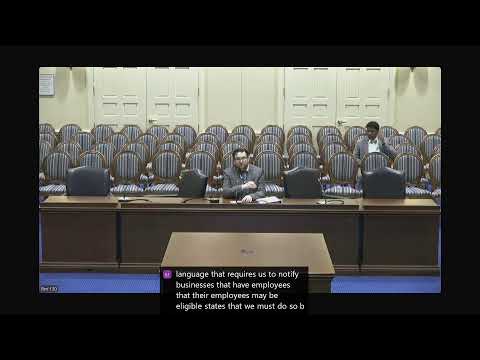
Senate Bill 663: Comptroller, earned income tax credit employer notifications Matt Dudzik of the Comptroller’s Office described SB 663 (crossfile of HB 603), which would allow the Comptroller to notify employers that their employees may be eligible for the federal earned income tax credit by electronic means rather than requiring mailed notices. Dudzik said the office currently spends about $145,000 per year on postage for those mailings, that the Comptroller’s online Maryland Tax Connect portal allows many businesses to receive electronic notices more efficiently, and that the bill would not eliminate mail as an option for employers without an electronic account or email address. He urged a favorable report.
What happened next At the close of the March 30 hearing the committee recessed and the transcript records the committee returning at 3 p.m. for a vote. The hearing record shows sponsors’ presentations and requests for favorable reports; it does not record final committee votes or any committee amendments adopted during the hearing.
Provenance: The summaries above are based on the hearing transcript segments where each bill was introduced and concluded (transcript excerpts shown below in the article’s provenance field).