Get Full Government Meeting Transcripts, Videos, & Alerts Forever!
Get email alerts on the Health Policy topic
No spam. Unsubscribe anytime.
HGO committee holds hearings on OTC birth control coverage, insurer rules, licensing compacts and aging programs
Summary
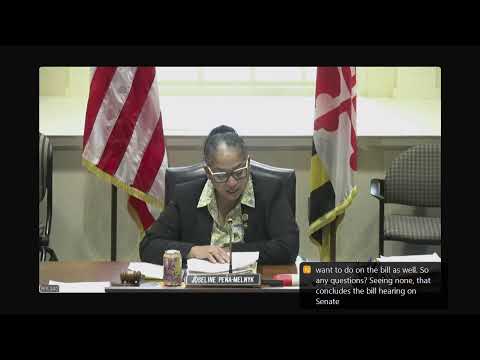
The Health and Government Operations Committee, chaired by Jocelyn Pena Milnek, held a series of bill hearings on measures affecting birth control access, insurance coverage rules, professional licensure compacts and programs for older Marylanders.
The Health and Government Operations Committee, chaired by Jocelyn Pena Milnek, held a series of bill hearings on measures affecting birth control access, insurance coverage rules, professional licensure compacts and programs for older Marylanders. Testimony came from bill sponsors, legislative representatives and agency officials; the committee concluded each hearing without recording a floor vote during this session.
Maryland-led OTC birth control implementation: Committee members heard sponsor testimony on Senate Bill 674, which would create a collaborative to implement Maryland’s existing requirements for coverage of over‑the‑counter (OTC) birth control. Corinne Wissman, testifying on behalf of Senator Hettleman, told the committee that "by 2024, only 139 claims for OTC emergency contraception were covered in nearly 2 years and just 4 claims for O pill, a new daily over‑the‑counter birth control pill in just 8 months." She said the collaborative would bring together state agencies, consumer representatives, pharmacies and insurers to develop guidance on claim submissions, raise consumer and provider awareness, and create pathways for community partners to provide OTC birth control to the uninsured. Wissman urged a favorable report.
Insurance access and coverage bills: Senators testified that several bills are in the same posture as House cross‑files and requested favorable reports. Senator Malcolm Augustine presented SB902 (health insurance access to nonparticipating providers, referrals and additional assistance) and asked the committee for a favorable report. Senator Jason Galli presented SB641 (require coverage for hearing aids), noting it is identical to the House cross‑file and that both versions passed unanimously in the House; he asked for a favorable report.
Young adult subsidy program: Senator Clarence Lam introduced SB5, which would repeal the sunset date on the Maryland Health Benefit Exchange’s State‑Based Young Adult Health Insurance Subsidies Pilot Program (the sunset was originally set for 2026). Lam said the program is funded by assessments on payers and argued that continuing the subsidy brings younger, generally healthier people into the insurance pool and can help reduce costs; he asked for a favorable report.
Licensure compact and workforce mobility: Senator Vinson (introducing SB174) described the Interstate Social Work Licensure Compact, saying the compact eases occupational licensing reciprocity among states, improves continuity of care, and helps relocating military spouses and others access social work services. The senator said Maryland would join other states that have adopted similar compacts for health professions and urged passage to address social worker shortages.
Telehealth, adverse‑decision reporting and related items: Committee members reviewed multiple bills in the same posture as House cross‑files, including SB372 (Preserve Telehealth Access Act of 2025) with a noted addition related to opioid services, SB474 (health insurance adverse decisions, notices, reporting and examinations) and SB776 (a work group to study rights related to adverse decisions in the state health care system). Sponsors and the chair indicated amendments or additions in some bills and requested favorable reports.
Departmental and aging program bills: Agency representatives presented departmental bills. Izzy Shikoff, director of housing services at the Department of Aging, asked for a favorable report on SB212 to consolidate and modernize three state‑funded programs administered by the Department of Aging, noting the bill is identical to House Bill 36. Sarah Case Heron, director of governmental affairs for the Maryland Department of Health, presented SB217, an omnibus departmental bill that includes sunset extensions for multiple health occupations boards and an increase in membership for the massage therapy board; she said the House and Senate cross‑files were amended in the same manner and requested a favorable report. Andrea Nunez, legislative director at the Department of Aging, asked for a favorable report on SB223 to expand the senior call check program (renamed to include social connections), noting the bill is in the same posture as House HB158 and that the committee had already voted favorably in the House committee.
Committee process and next steps: Chair Jocelyn Pena Milnek opened and closed each bill hearing and repeatedly noted that many bills were “in the same posture” as House cross‑files to expedite testimony. Several presenters thanked the chair and committee; members asked a few clarifying questions but the transcript shows no formal recorded votes on any bill during this hearing. Each bill’s sponsor or agency representative requested a favorable report to advance the cross‑file to the next stage.
The committee concluded the day’s bill hearings and asked members to remain briefly afterward for internal matters.