Get Full Government Meeting Transcripts, Videos, & Alerts Forever!
Get email alerts on the Multilateralism International Crises topic
No spam. Unsubscribe anytime.
UN secretary-general urges EU to bolster multilateral response on Ukraine, Gaza and climate
Summary
António Guterres, the United Nations secretary-general, told officials in Brussels that the EU is a ‘‘fundamental pillar’’ of the multilateral system and urged action to secure a just peace in Ukraine, restore humanitarian access and release hostages in Gaza, and accelerate emissions cuts to meet the 1.5°C goal.
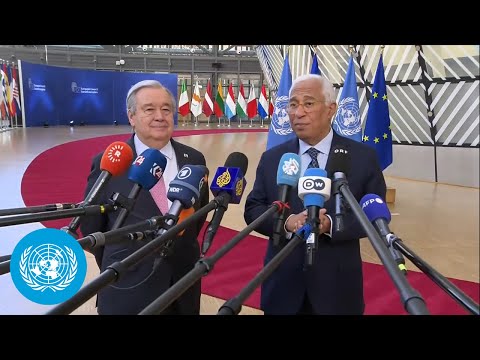
António Guterres, the United Nations secretary-general, said in Brussels that the European Union is a “fundamental pillar of the multilateral response” to crises including the war in Ukraine, the fighting in Gaza and worsening global temperatures.
Guterres said any ceasefire in Ukraine is welcome but must “pave the way for a just peace in Ukraine” that respects the UN Charter, international law and Security Council resolutions on Ukraine’s territorial integrity. He also renewed an appeal for “respect of the ceasefire, for unimpeded humanitarian access to all areas of Gaza, and for the immediate and unconditional release of the hostages.”
Why it matters: Guterres’ remarks were addressed to European interlocutors during a Brussels appearance in which he stressed continued EU political and financial support for UN activity. His comments connect diplomatic priorities — territorial integrity, humanitarian access and hostage releases — with the UN’s broader multilateral agenda, including climate and development finance.
Guterres said the United Nations and the EU must press for a two-state outcome in the Israeli–Palestinian conflict, calling it “the only way to bring peace to the Middle East, which is to have a Palestinian state side by side with an Israeli state.” He described the scale of civilian suffering in Gaza as “too much” and urged measures to protect civilians.
On climate, Guterres cited a recent World Meteorological Organization report and warned that record heat and other indicators show the planet is approaching dangerous thresholds. “The report also says that 1.5 degree limit is still possible in relation to global warming,” he said, and added that the international community must “double down in reduction of emissions, double down in decarbonization, and double down in the replacement of fossil fuel by renewable energy.”
Guterres thanked the EU for “continued support, both financial support and political support to the activities of the UN” and for backing the implementation of the Pact for the Future, the Paris Agreement, and forthcoming international meetings he named — including a financing for development conference scheduled in Seville in July and later multilateral moments such as the G20 and COP meetings.
At one point he thanked a host in the room, saying he was “very happy to be back in Brussels and, especially to be able to work with President Antonio Korsner.” Earlier in the session, the host had opened by welcoming Guterres and underscoring the need to “strengthen our multilateral system and first of all, to strengthen United Nations positions.”
A reporter asked whether the United States’ withdrawal from some UN bodies signaled that “a new world order is being written as we speak where multilateralism and the international community don’t play a role anymore.” Guterres replied: “Multilateralism is alive. It’s playing a role. And the proof of that is the fact that I’m here with the European Union.”
No formal decisions, votes or binding agreements were recorded during the remarks; the session was a public set of statements and exchanges about priorities and international cooperation.