Get Full Government Meeting Transcripts, Videos, & Alerts Forever!
Get email alerts on the School Finance topic
No spam. Unsubscribe anytime.
Darien finance committee forecasts $462,859 surplus after state adds $40 million for excess special-education costs
Summary
The Darien Board of Education finance committee reported a projected $462,859 surplus through February driven largely by a state appropriation for excess special-education costs, discussed recommended budget transfers and options for using one-time funds including pre-purchasing equipment or creating a non‑lapsing account.
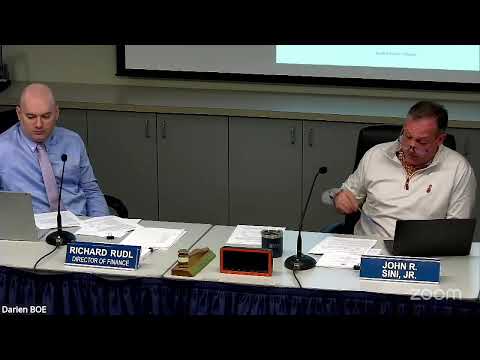
Rich, a district finance staff member, told the Darien Board of Education finance committee on March 20 that the district is showing a projected surplus of $462,859 through February 2025, an improvement of $510,557 from January. "We are showing the projected surplus now of 462,859," he said.
The committee heard that the improvement stems mostly from a state appropriation for excess special-education costs. Rich said the state passed a conditional $40,000,000 appropriation that added about $503,762 to Darien's forecast and raised the district's estimated excess-cost reimbursement rate to about 72.8% based on December 1 submissions. He cautioned that the rate could change when March 1 claims are finalized.
The district recorded its first reimbursement on the state claim—about $1,700,000—in February; Rich said the state typically pays the balance in May. He described the mechanics of receipt: the money is deposited by ACH into a shared town account and then recorded by the school district on the excess‑cost line item, followed by a town–board reconciliation.
Committee members asked how the statewide claims pool affects Darien’s rate. Rich explained the reimbursement model is sensitive to what other communities file: "Our reimbursement rate is impacted by what Danbury's, you know, Bridgeport was in or New Canaan puts in. And so all those factors play into what we'll get." He added that the $40,000,000 allocation is a one‑time infusion tied to December 1 claims and that the governor's proposed budget included another $40,000,000 for a later year but not yet passed.
On program and grant items, Rich said federal grant funding to the district—primarily IDEA and a smaller Title II award—amounts to roughly $1 million overall, with Title II near $30,000. The committee was also told that Greg Darren, the district’s TechEd teacher leader, applied for and won a Perkins grant award of $34,000 to support school‑to‑career work such as video broadcasting and woodworking; Rich said those funds become available in April and must be spent by June 30.
Committee members reviewed several line‑item variances: a projected special‑education consultant services deficit of about $98,000 (mostly behavioral services and coverage while a District BCBA is on medical leave), an ELP tuition deficit of $30,975 tied to newly classified students, small savings in custodial and substitute accounts, and a food‑service deficit of about $2,148. Overall special‑education reimbursements were reported as a net positive $435,919, contributing to the projected total surplus.
The committee recommended two budget transfers to be presented to the full Board for approval: a $98,000 transfer to RC 24 consultant services (funded from tuition) to cover services for students returning to the district and interim coverage; and a $30,975 transfer to ELP tuition (funded from tuition) for newly classified students. These transfers were recommended by staff at the meeting but were not voted on by the finance committee that morning.
Members spent notable time discussing options for using one‑time surplus funds if the May reimbursements arrive as projected. Administration provided a memo listing potential uses that would meet the requirement that any pre‑purchased item be expensed before June 30; suggested items included ViewSonic classroom displays slated for replacement, middle‑school lab desktops (~$23,000), grade‑5 Chromebooks, wireless access‑point replacements, administrative laptops and one‑time equipment purchases. An alternate option discussed was establishing a non‑lapsing (unexpected education) account under the statute the administration cited as "Public Act 2,445," which would allow carrying one‑time surplus forward for non‑recurring expenditures so long as the balance does not exceed 2% of the board's operating budget. Committee members noted districts use such accounts for non‑recurring capital or study expenses but emphasized any decision should await final May receipts and the town appropriation process.
Rich recommended waiting until May—when the district typically receives the full state reimbursement—before making final spending decisions. The committee agreed to consider any pre‑purchases or a non‑lapsing account at the committee and board meetings in May.
The meeting also included brief operational notes: the ABS vendor that monitors the district’s HVAC building management system will end support for its current software, which will require an upgrade for several school buildings; and the district will likely need to track carryforward or one‑time purchases carefully to avoid creating volatility in future budgets. No formal votes on spending or creation of a non‑lapsing account were taken at the finance committee meeting.
The finance committee plans to revisit transfers and any decision about accelerated purchases or a non‑lapsing account at its May meetings and to present recommended transfers to the full Board of Education for action.