Get Full Government Meeting Transcripts, Videos, & Alerts Forever!
Get email alerts on the Governance Boards topic
No spam. Unsubscribe anytime.
CITT urges Board of County Commissioners to exempt the trust from proposed ordinance limiting county boards’ external advocacy
Summary
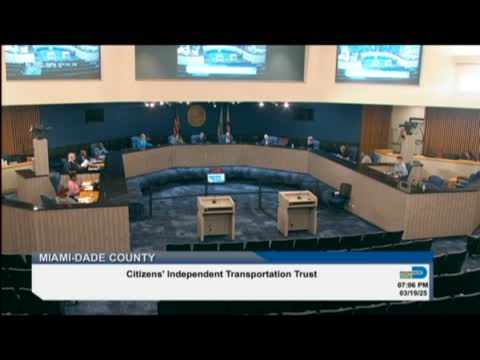
The Citizens Independent Transportation Trust passed a resolution on March 19 asking the Miami-Dade Board of County Commissioners to exempt the CITT from a proposed ordinance that would restrict county boards from making policy statements or petitions to entities other than the BCC.
The Citizens Independent Transportation Trust voted on March 19 to urge the Miami-Dade Board of County Commissioners to exempt the CITT from proposed ordinance language that would bar county boards from "urging, recommending, or stating a policy position to any public or private entity other than the BCC."
Executive Director Javier Bettencourt told trustees he had reviewed the proposed ordinance and was concerned it would cover the CITT. "I became aware of an item on first reading... that sought to prohibit all county boards from either urging, recommending, or stating a policy position to any public or private entity other than the BCC," he said. Bettencourt asked trustees to adopt a resolution asking the BCC to clarify or exempt the CITT, citing the trust's role as an independent body established under the People’s Transportation Plan.
Bettencourt read language from a recent Miami-Dade County grand jury report to support the request, quoting the report that "the citizens of Miami-Dade County intended and wanted the tax monies collected pursuant to the ordinance to be managed by an independent body of citizens who are free of political and personal interest." He also referenced the PTP resource guide language that described the CITT as "a truly independent decision-making body separate from the government."
Trustees debated the matter and several said the proposed ordinance was vague and could be interpreted to curtail normal oversight and advocacy that CITT has performed. Member Paul Schwab noted the trust’s history of working with the BCC and said the request for an exemption was intended to preserve the trust’s oversight role, not to create conflict with commissioners. Several trustees said if the ordinance’s purpose was solely to restrict advisory boards it may not have been intended to capture trust bodies with independent, statutory roles.
Formal action: The trust passed resolution 7c as amended (the amendment attached a page of the grand jury report as "Exhibit C") and voted to submit it to the Board of County Commissioners and staff for meetings and public comment at the BCC committee hearing. Trustees were advised the matter was likely headed to the BCC’s Policy Council for public hearing; staff said they would request meetings with commissioners and attend the committee hearing to present the trust’s position.
Ending: The trust will forward the resolution and supporting materials to the Board of County Commissioners, seek meetings with commissioners and speak at the scheduled committee public hearing. Trustees asked staff to monitor the ordinance’s progress and report back to the trust.