Get Full Government Meeting Transcripts, Videos, & Alerts Forever!
Get email alerts on the Buses Brt topic
No spam. Unsubscribe anytime.
Miami-Dade’s 20-mile South Corridor BRT scores gold in design; service targeted for summer launch
Summary
Miami-Dade County’s BRT South Corridor design earned a gold standard rating from the Institute for Transportation and Development Policy, county officials said, and the transit department is aiming for a phased service launch this summer with electric buses and center-platform stations.
Miami-Dade County officials said the South Corridor bus rapid transit (BRT) project has achieved a preliminary gold-standard rating under the Institute for Transportation and Development Policy (ITDP) and is on track for a summer 2025 service launch with 100% electric buses and center-platform stations.
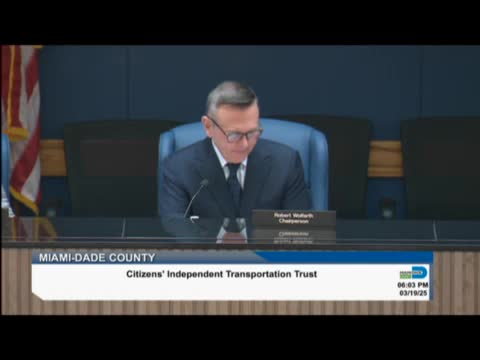
County officials said the 20-mile corridor will include 14 BRT stations, dedicated right-of-way, level boarding platforms and off-board fare collection. "This corridor is a 0-emission corridor with 100% electric buses," Jose Alvaro Diaz, interim director of the Department of Transportation and Public Works (DTPW), told the Citizens Independent Transportation Trust on March 19. Diaz said the county’s preliminary ITDP score reflected design elements including signal priority, platform-level boarding and station weather protection.
The county framed the achievement as a policy goal set by a 2018 Board of County Commissioners resolution directing pursuit of ITDP standards. Diaz said funding for the project’s capital budget is a mix of FTA, FDOT and local PTP (People’s Transportation Plan) funds—each covering roughly 33 percent of the program’s cost. He added that companion projects such as the Transit Operations Center remain part of the program’s overall delivery plan.
Why it matters: Gold-level ITDP ratings are rare in the U.S.; the design-level score positions the South Corridor to compete for federal support and raises expectations for service quality. Officials said design is only the first step: ITDP re-evaluates corridors after operation begins and may adjust the score based on performance.
Officials described service plans at the meeting. Peak headways will be about 7.5 minutes with 15-minute off-peak frequency, and the system will include limited-stop BRT service plus more closely spaced local service to preserve access for riders who board between BRT stations. Diaz said "we want to continue to provide frequent and closely spaced service to our community, particularly those that are captive to transit." The project also includes provisions for secure bicycle parking and future conversion to rail if demand and conditions warrant.
On timing, Diaz said gates and signal equipment at some intersections are already active and that full service launch is the department's goal for July 2025, though several trustees urged flexibility on the date to ensure a coordinated public rollout. "That is still our goal," Diaz said when asked about a July start; later he added that about 20 intersection gates were active at the time and that the remainder are being installed.
Trust members and staff discussed operational readiness and the ITDP scorecard. Diaz said the county worked with ITDP on a 2016-standard design score and that his team will continue to work with the ITDP and the transit industry to protect the corridor’s score once it begins operating. He also said the Federal Transit Administration (FTA) project-development reviews and the county's program governance structure remain active elements of the project’s schedule.
What’s next: DTPW will continue construction, finalize fare equipment and testing protocols required by FTA, and proceed toward system acceptance and operation. The CITT and DTPW said they will keep trustees informed; the county executive director said the trust will be part of planning for a formal ribbon-cutting and community launch.
Ending: Trustees praised the department for progress on design and implementation while urging ongoing public outreach and careful scheduling of the service launch to maximize ridership and minimize operational issues during the early months.