Get Full Government Meeting Transcripts, Videos, & Alerts Forever!
Get email alerts on the Student Centered Funding Formula topic
No spam. Unsubscribe anytime.
Assembly subcommittee reviews community college funding: COLA, enrollment growth and formula fixes debated
Summary
The Assembly Budget Subcommittee No. 3 heard presentations and questions about the governor's proposals for a 2.43% COLA, modest enrollment growth funding, and technical changes to the Student-Centered Funding Formula (SCFF), including requests to lift a 10% local growth cap and use a greater-of-current-year-or-3-year-average for apportionments.
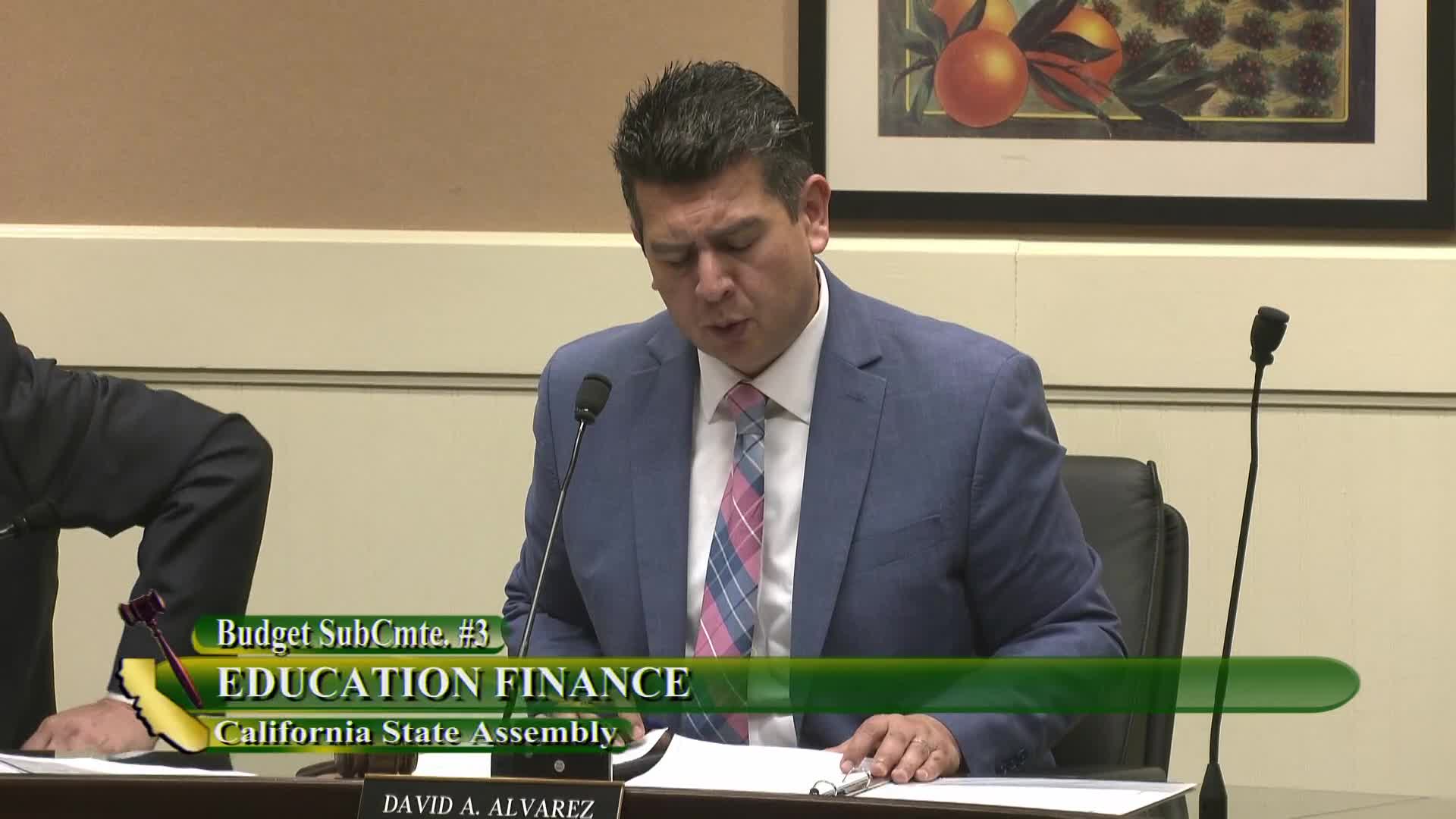
Assemblymember Alvarez, chair of the Assembly Budget Subcommittee No. 3 on Education Finance, opened a May hearing on the California Community Colleges' budget proposals, pressing for details on how each item would improve graduation rates and access to higher education.
Justin Hurst of the Department of Finance described the governor's apportionment proposals for the Student-Centered Funding Formula (SCFF). "The governor's budget proposes a cost of living adjustment at the rate of 2.43% in the amount of 230,400,000 proposition 98 general fund for apportionments," Hurst said, and he added the budget proposes funding enrollment growth at 0.5% with about $30,400,000 in Proposition 98 General Fund.
Lisa King of the Legislative Analyst's Office (LAO) said the LAO finds the COLA proposal reasonable and recommended at least the governor's 0.5% enrollment growth funding, noting regional variation in recovery from the pandemic and other factors that affect future enrollment.
Chris Ferguson, Executive Vice Chancellor for Finance and Strategic Initiatives at the California Community Colleges Chancellor's Office, asked the subcommittee to consider higher growth funding. Ferguson said the Chancellor's Office projects unfunded enrollment growth near $126,000,000 and asked the Legislature to consider two policy changes: (1) compute apportionments using the greater of the current year or the three-year average (estimated at about $20,000,000 annually), and (2) remove the local 10% annual growth cap (about $15,600,000 attributable to six districts), which together would better align funding with districts that are rapidly expanding.
Members pressed for details on who would benefit and for analyses of alternatives. Assemblymember Muratsuchi described his experience as an adjunct faculty member at El Camino College and supported hearing from the system. Several committee members asked the Chancellor's Office and LAO for scenario costings showing the fiscal impact of combinations of COLA, 0.5% versus higher growth, and lifting the 10% cap.
The committee also heard comments from trustees and college leaders calling for broader COLA coverage and warning that some districts remain on hold-harmless or stability protections rather than fully on SCFF. The Chancellor's Office and LAO agreed they could provide more district-level analyses to help the Legislature weigh trade-offs between growth funding and categorical dollars.
The subcommittee left the issue open for follow-up at the May Revision and asked staff to model the budgetary impacts of different growth and policy options.