Get Full Government Meeting Transcripts, Videos, & Alerts Forever!
Get email alerts on the Housing Supply Policy Michigan topic
No spam. Unsubscribe anytime.
Municipal League and Realtors tell committee zoning, funding and public education are needed to tackle Michigan's housing shortage
Summary
Presenters from the Michigan Municipal League and Michigan Realtors briefed the House Committee on Regulatory Reform about municipal obstacles to housing supply, state programs intended to help localities, and policy options including zoning reform, preapproved plans and incentives tied to local reforms.
The Michigan House Committee on Regulatory Reform heard presentations from the Michigan Municipal League and the Michigan Realtors on Thursday about barriers to increasing housing supply across Michigan and possible policy responses.
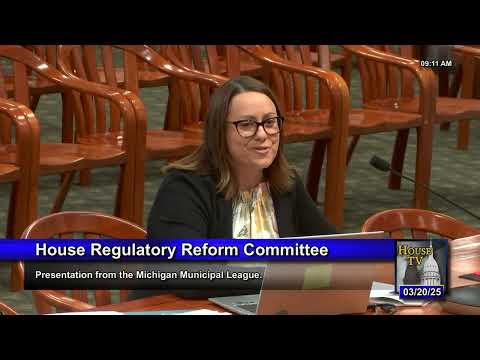
Jen Riggtrink, who identified herself as with the Michigan Municipal League's state and federal affairs team, told the committee that communities face a shortage of housing supply and rising costs to build or rehabilitate housing. "We have more need than we have supply," Riggtrink said. She outlined a multi-pronged view of obstacles often summarized to the "five Ls": labor, lumber, land, laws and lending. Riggtrink emphasized that zoning reform is only one piece of the puzzle and said local resistance (commonly called NIMBYism) and owners unwilling to sell or redevelop also slow progress.
Riggtrink described state-supported programs intended to help communities prepare for development, including the Redevelopment Ready Communities program (which she said was taken statewide beginning in 2012), the Housing Readiness Incentive Grants funded in recent state budgets, and a zoning-reform toolkit and "pattern book" of preapproved housing plans. She said communities use the readiness grants primarily for technical assistance, such as updating housing plans or zoning, and that the housing readiness program has been funded in the last two budgets but that those grants require time to be implemented locally.
Brad Ward, vice president of public policy and legal affairs for the Michigan Realtors, told the committee the state is experiencing a substantial supply shortage and suggested regulatory and procedural reforms to reduce costs and delays. Ward said housing inventory in Michigan was "below two and three quarter months" and contrasted that with a typical stable market of about six months of inventory. He cited median price figures from 2024 and 2021: $230,000 in 2024 and $211,000 in 2021. Ward also described what he called a "double lock-in" effect: higher mortgage rates plus property tax dynamics under Proposal A that can discourage homeowners from downsizing.
Both presenters recommended policies to increase housing production and affordability. Riggtrink proposed incentivizing local zoning reforms ("carrots versus sticks") and recognizing communities that have already updated rules through prioritization for limited state housing dollars. Ward recommended common-sense zoning reforms such as reducing parking minimums, streamlining approvals, and permitting duplexes, triplexes and similar modest increases in density in single-family zones. He emphasized public education to reduce opposition rooted in misinformation.
Committee members asked several clarifying questions, including how the housing readiness grants are awarded and whether Redevelopment Ready Communities is focused specifically on housing (Riggtrink clarified it is a broader municipal readiness program that supports planning, zoning and marketing of priority sites). Representative Grant noted the state remains short of housing and pressed for an estimate of how long implementation would take; Riggtrink said the program is not a housing subsidy but a local capacity program and implementation timelines vary by community. Representative Tisdel asked whether communities are removing height limits or opening up density; Riggtrink pointed to preapproved plans and local reforms as tools communities use, and recommended additional data gathering to identify which municipalities have updated zoning codes.
Both presenters stressed that addressing Michigan's housing shortage will require multiple coordinated actions: funding, code reform, technical assistance, and public outreach.
The committee record does not show formal votes on housing policy during this meeting; both presentations were informational.