Get Full Government Meeting Transcripts, Videos, & Alerts Forever!
Get email alerts on the Foreign Influence Legislation topic
No spam. Unsubscribe anytime.
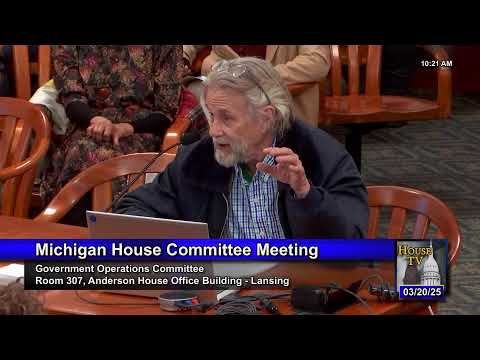
House committee hears wide-ranging foreign-influence bill package; debate centers on definitions, enforcement and civil liberties
Summary
The Michigan House Committee on Government Operations on an unspecified date took testimony on a multi-bill package aimed at limiting foreign influence in economic incentives, education, land ownership and data systems.
The Michigan House Committee on Government Operations heard testimony on a package of bills described by sponsors as measures to limit foreign influence in state government, schools, economic incentives and land ownership.
Sponsors and witnesses presented multiple bills including measures to (a) prohibit foreign principals from purchasing or acquiring certain agricultural land (House Bill 4233, as H-1 substituted), (b) bar foreign principals from acquiring property within 20 miles of military installations or key facilities (House Bill 4234), (c) prohibit the Michigan Strategic Fund from knowingly entering incentive agreements with entities from designated foreign countries of concern (House Bill 4241), (d) restrict public schools and institutions from entering certain cultural exchange agreements with specified foreign countries (House Bill 4238), (e) require disclosure of gifts and constraining agreements with foreign entities by public bodies and state agencies (House Bill 4240), and (f) require certain health-record technology to be physically maintained in the U.S. or Canada (House Bill 4242) as described in testimony read by a legislative staffer.
Proponents, including several bill sponsors and public commenters, said the measures respond to national-security risks and protect state assets. Representative Hoadley told the committee the Michigan Strategic Fund restriction is "a matter of national security," and Representative Jenkins Arno described HB4238 as a "straight forward common sense measure" to ensure "foreign countries of concern have 0 influence over our kids." Representative Schutte framed HB4240 in national-security terms and drew on his prior Department of Defense experience to argue public institutions should avoid constraining agreements with foreign actors.
Marla Riley Braun, legislative director for Representative Jamie Thompson, read Thompson's written testimony supporting HB4242 and cited recent cyberattacks on health care providers: "Ensuring that our medical care record technology is physically maintained in The US or Canada, as my bill does, is a needed step Michigan should take to protect the personal and private health information of our constituents." That testimony referenced the U.S. Department of Health and Human Services breach records as the information source.
Opponents and public-interest groups raised legal and practical concerns. The Michigan Realtors and the Michigan Land Title Association urged revisions to definitions, requested bona fide-purchaser protections and warned the bills could create significant administrative burdens for title and settlement professionals. David Martin, president of the Michigan Land Title Association, told the committee settlement agents cannot determine whether a buyer is a "foreign person" from public records and asked for clarifying language protecting valid lien holders and bona fide purchasers.
Civil-rights and immigrant-advocacy groups, including the American Civil Liberties Union of Michigan, Rising Voices and American Citizens for Justice, argued the bills risk discrimination and recalled historical "alien land laws." Kyle Zawakeen, legislative director for the ACLU of Michigan, said, "These bills pose serious threats to civil liberties" and urged careful legal review.
Committee members questioned sponsors about several recurring issues: how the bills define "foreign country of concern," whether the named list of countries can be updated without returning to the Legislature, how majority-ownership thresholds would be handled for entities with minority shareholders, what enforcement mechanisms would be used and who would initiate investigations (Secretary of State filings, Register of Deeds records, the attorney general, or county prosecutors). Sponsors generally pointed to enforcement through existing state mechanisms — registration with the Secretary of State, reporting to the attorney general and use of circuit court proceedings for divestment — while acknowledging areas of ambiguity the committee and stakeholders raised.
Specific clarifications offered in discussion included that the H-1 substitute to HB4233 narrows the bill to "foreign principals from foreign countries of concern," and that the bill allows a two-year divestment period for land acquired by inheritance or through legal debt-collection processes. Committee members and witnesses repeatedly flagged the 20-mile restriction around military installations and the broad statutory definition of "key facilities" (which includes utilities, manufacturing, rail yards, telecommunication facilities and cellular infrastructure) as enforcement and scope challenges.
Public commenters presented a range of perspectives: supporters warned of strategic, long-term influence and cited specific concerns about investments by entities tied to the People's Republic of China and firms such as Contemporary Amperex Technology Limited (CATL); opponents stressed constitutional and civil-rights risks and warned these measures could have chilling effects for immigrants, university communities and lawful permanent residents.
The committee adopted an H-1 substitute for House Bill 4233 that narrows its scope; the clerk recorded three yeas, zero nays and two passes on that motion. No additional committee votes to report those bills were recorded in the transcript.
Next steps: several sponsors invited stakeholders to work with them on drafting clarifications; committee members signaled the need for additional legal and implementation detail before advancing several bills.