Get Full Government Meeting Transcripts, Videos, & Alerts Forever!
Get email alerts on the Family Affordability topic
No spam. Unsubscribe anytime.
House committee hears bills to cut child costs: state child tax credit, childcare savings accounts, and baby-item tax exemptions
Summary
Sponsors presented House Bills 4055–4059 to the House Committee on Economic Competitiveness proposing a state child tax credit tied to the federal credit, tax-preferred childcare savings accounts, and exemptions of sales/use tax on baby and toddler items. Supporters and opponents testified; no committee vote was taken.
Representatives sponsoring a package of bills aimed at reducing the cost of raising children explained the measures to the Michigan House Committee on Economic Competitiveness and answered committee questions; several advocacy groups then offered testimony for and against the package.
Representative Schuette, introducing House Bills 4055 through 4059, told the committee the bills “aim to address an important problem that is facing our state: it’s too expensive to raise a family.” The sponsors described three core elements: a state child tax credit, a tax-preferred childcare savings program, and sales/use-tax exemptions for infant and toddler items.
House Bill 4055 would create a state income tax child tax credit equal to 50% of the federal child tax credit. "It would be 50% of the federal tax credit," Schuette said, "meaning that a family in Michigan could get as much as, you know, a thousand dollars currently and maybe $500 in future years depending on what happens federally." The bill sponsors said the state credit is intended to put cash back into families’ pockets to help with basics such as groceries and utilities.
House Bills 4056 and 4057 would establish a childcare savings program modeled in part on other tax-advantaged savings accounts. Sponsors described the draft framework as allowing families to place up to $20,000 into joint, tax-deductible accounts for qualified childcare expenses. Representative Schuette compared the proposal to health savings accounts and 529 education accounts as an incentive to save.
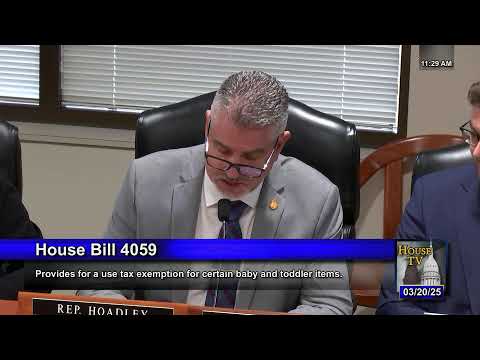
House Bills 4058 and 4059 (introduced by Representatives Schmaltz and DeBoer in the package) would remove state sales and use tax on a list of baby and toddler items. The testimony and bill text read into the record named items such as cribs and playpens, strollers, safety gates and cabinet locks, car seats and bicycle child carriers, breast pumps and storage supplies, bottles and sterilizers, diapers and wipes, changing tables and pads, baby and toddler clothing, and related supplies.
Testimony in support came from multiple business and advocacy groups and individuals. Genevieve Marmon, legislative director for Right to Life of Michigan, urged the committee to support the package, saying the tax relief “is an excellent start to help ease this financial burden” and arguing targeted incentives make it easier for parents to choose to have children. The committee also read support cards from the Grand Rapids Chamber, Detroit Regional Chamber, Small Business Association of Michigan, Michigan Manufacturers Association, Michigan Chamber, HighScope Educational Research Foundation, Michigan Catholic Conference, Michigan Council for Maternal and Child Health, and the Consumer Healthcare Products Association.
The Michigan League for Public Policy, represented by Rachel Richards, expressed support for measures that help families but raised a concern about HB4055’s tie to the federal credit. Richards said the federal child tax credit excludes some of the lowest-income families and warned that “about 1 in 4 Michigan children are left out of the federal child tax credit,” urging the committee to consider ways to avoid excluding very low-income households.
Committee members asked sponsors questions about targeting and eligibility. Representative Bridal asked whether income limits could be attached so credits are targeted to families with greater need; sponsors replied that the state credit is linked to the federal structure and that the federal credit contains an income phase-out (sponsors cited a $200,000 phase-out threshold for joint filers). On the childcare savings program, committee members asked whether accounts would be income-qualified; sponsors said the draft limits total contributions but does not restrict who may open an account and compared the design to other broadly available tax-advantaged accounts.
No committee vote occurred; the sponsors said they would return when the bills receive a committee vote. The committee read into the record several organizations opposing aspects of the package, including the Michigan Association of Superintendents and Administrators, the Michigan Association of Secondary School Principals, the Michigan Association of School Boards, and the Michigan Alliance of Student Opportunity.
The sponsors and supporters argued the package would provide targeted relief to families and help address Michigan’s declining birth rate and population stagnation. Advocates pressing for changes asked the committee to consider income targeting or alternative structures so the lowest-income children are not excluded.