Get Full Government Meeting Transcripts, Videos, & Alerts Forever!
Get email alerts on the Cottage Food Law Reform topic
No spam. Unsubscribe anytime.
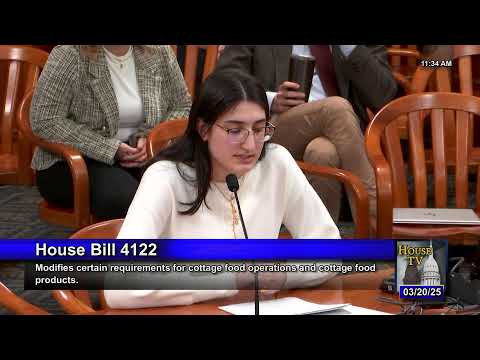
House Agriculture Committee hears testimony on bills to modernize Michigan cottage food law; sponsors propose higher sales cap, online sales and optional MSU-BC
Summary
The House Agriculture Committee received testimony on House Bill 4122 and related language to modernize Michigan’s cottage food law, including raising the $25,000 gross-sales cap to $50,000, allowing online and third-party delivery sales, and creating an optional registration through the MSU Product Center.
Lansing — The Michigan House Agriculture Committee heard testimony on House Bill 4122 and companion language on House Bill 4245 to update the state’s cottage food law, including proposals to raise the gross annual sales cap, allow online and mail sales and create an optional registration through Michigan State University’s Product Center.
Representative Alexander, introducing HB 4122, told the committee the bill would raise the gross-sales cap for cottage food operations from $25,000 to $50,000 and set a higher $75,000 cap for individual products priced $250 or more, with the overall cap tied to the Detroit consumer price index so it adjusts for inflation. The bill would explicitly allow online sales, mail orders and third-party delivery platforms while preserving a requirement that the consumer have direct interaction with the producer — either in person or virtually — before purchase. The bill would also create an optional registration system administered by the MSU Product Center so producers could list a registration number on labels instead of a home address.
“Michigan’s cottage food law has provided an important pathway for small-scale food processors to start and grow their business,” Representative Alexander said. “This bill modernizes the law while maintaining important food-safety guards.” He noted that the law was enacted in 2010 and that the Michigan Department of Agriculture and Rural Development (MDARD) has reported no confirmed foodborne illness linked to cottage foods since then.
Supporters that testified included the Michigan Farm Bureau, which backed both HB 4122 and HB 4245; the Michigan Farmers Market Association (MIFMA); the MSU Product Center; local producers who use cottage food rules to diversify farm income; and advocacy groups representing immigrant and women entrepreneurs.
Rebecca Park of the Michigan Farm Bureau said the $50,000 threshold matches a common minimum required for small-business loan eligibility and reflects discussions with MDARD. “The cap is designed to mitigate risk by incentivizing businesses that exceed it to transition to licensed commercial production,” she said.
Kevin Hershberger, who operates a farm market in Cass County and has expanded sales through cottage food products, described how the program helped diversify farm income and provide local jobs. Molly Woods of the MSU Product Center said the center provides education, technical support and assistance on labeling and licensing and that many clients start as cottage food producers before moving to licensed production.
Witnesses and committee members asked questions about whether the cap should be higher — some members suggested figures as high as $70,000 or $75,000 — and whether registration should be mandatory rather than voluntary. Representative Leitner and others urged the committee to consider a higher cap to better support producers seeking a livable income.
The bill language allows for a voluntary registration system with an optional fee (the bill allows for a nominal fee up to $50) to sustain the MSU Product Center’s administration of the registry and to protect producer privacy by allowing use of a registration number instead of a home address on product labels. Speakers clarified that cottage food products are shelf-stable, not time-and-temperature controlled, and that sales of those items are not subject to Michigan sales tax; producers still pay personal income tax on earnings.
Supporters emphasized the program’s role as a low-barrier entry point for entrepreneurs, including immigrant and women-led businesses. Brenda McDussi of Rising Voices said the changes would expand opportunities for Asian American, immigrant and women entrepreneurs who often begin businesses at home.
No committee vote on HB 4122 or HB 4245 was recorded during the hearing. The committee read testimony from MDARD as recorded on the hearing sheet and noted more than 20 written messages of support had been received. Representative Alexander indicated colleagues could offer amendments to change the cap if the committee wished to do so.
Committee Chair Nyar closed the bill testimony portion of the hearing and the committee proceeded to other items on the agenda.