Get Full Government Meeting Transcripts, Videos, & Alerts Forever!
Get email alerts on the Statewide Case Management System topic
No spam. Unsubscribe anytime.
Michigan Supreme Court urges ongoing funding to finish statewide case management system
Summary
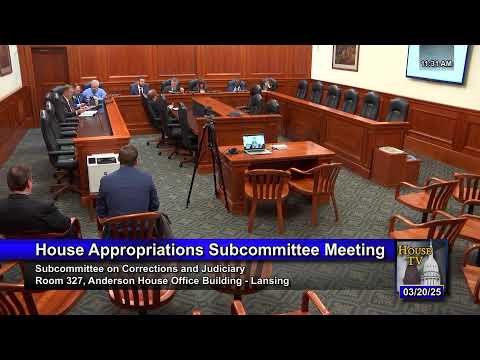
Chief Justice Clements told the House Appropriations Subcommittee on Corrections and Judiciary on Thursday that Michigan's statewide case management system (CMS) is central to efforts to make courts more data-driven, efficient and accessible, and asked lawmakers for $7.2 million in ongoing funding to scale staffing and support as the system is brought online across the state.
Chief Justice Clements told the House Appropriations Subcommittee on Corrections and Judiciary on Thursday that Michigan's statewide case management system (CMS) is central to efforts to make courts more data-driven, efficient and accessible, and asked lawmakers for $7.2 million in ongoing funding to scale staffing and support as the system is brought online across the state.
Clements said the statewide CMS "is so important and drives much of what we want to accomplish as a data-driven branch of government," and described progress and outstanding needs during a presentation to the committee.
The request comes after the Legislature in 2022 approved a one-time appropriation of $150,000,000 to build out a statewide CMS; Clements told the panel that roughly $65,000,000 has been spent or obligated and about $85,000,000 remained. The State Court Administrative Office (SCAO) also requested $38,000,000 in ongoing operating funds in 2022 that was not approved; the new $7.2 million request is a step toward that long-term need, Clements said.
Clements said adoption of the Judicial Information System (JIS) is well underway: "As of February 2025, 250 of 302 courts are using JIS," she said, listing 69 circuit courts, 107 district courts and 74 probate courts. She said SCAO has engaged discussions with additional courts, has commitments from several and is actively onboarding others, but that the remaining courts are among the largest and most complex.
Why it matters: Clements and SCAO officials told the subcommittee the CMS will standardize data collection statewide, reduce duplicative local licensing and IT costs, improve interoperability with law enforcement and other justice partners, and enable broader online court services such as e-filing. SCAO estimated annual savings of more than $700,000 in three mid-to-large counties (Saginaw, Ingham and Kalamazoo) after switching from private vendors to the JIS system.
Clements outlined implementation challenges, including messy historical data from roughly 12 different legacy case-management platforms (five of them homegrown) and local courts' limited staff bandwidth to manage migrations while continuing operations. To address that, SCAO provides reimbursements to local funding units to cover overtime or temporary staffing during onboarding.
In addition to the CMS funding, Clements asked for a series of smaller ongoing investments to build SCAO capacity: three field-service FTEs for court support and plain-language form work; additional finance and human-resources capacity to implement best-practice audits (one audit of each trial court every four years, estimated 61 audits per year); staffing for the Michigan Judicial Institute to expand mandatory and specialized training for judges and court staff; a legal editor position in the reporter of decisions to reduce an editing backlog (one FTE estimated at roughly $167,000); and a permanent grant officer to pursue federal grant opportunities.
Clements also highlighted public-facing projects: Michigan Legal Help logged more than 3,000,000 visits last fiscal year, with SCAO reporting that more than 80% of users self-reported incomes at or below 200% of the federal poverty level; roughly 150,000 users completed DIY forms, including nearly 40,000 personal protection-order forms. MiFILE, the statewide e-filing backbone, added nearly 30,000 registered users this year and is expected to reach 100 courts on the statewide backbone in the coming year.
On juvenile justice, Clements said SCAO has established a juvenile justice office within its child welfare division, developed juvenile-specific probation standards, trained nearly 400 individuals, and administered virtual training and status-offense diversion grants supporting up to five courts.
Public comment on the CMS: Peter DePhillips, a pro se litigant who testified remotely, told the committee he believes the CMS's use of algorithms has produced unfair judge assignments in his cases and that he has repeatedly received assignments to a small subset of judges. He said his observations prompted meetings with legislative offices last year and urged lawmakers to scrutinize the CMS operations before approving more ongoing funding. DePhillips said he would provide written documentation to committee members.
Committee action and next steps: The subcommittee approved the minutes from its March 13, 2025 meeting at the start of the session by voice vote after Representative Cabot moved to approve and no objections were recorded. No formal appropriation vote occurred during this hearing; SCAO staff and the chief justice said they would provide additional documentation and timing details on onboarding schedules, staffing plans and comparative state models if the subcommittee requested them.
Clements and SCAO members called for continued legislative support to complete onboarding and to fund ongoing operations, with the specific ask this year for $7.2 million in ongoing funds to scale staffing and compute resources as more courts migrate to the statewide system.
Questions from members covered how many states have unified systems, the definition of "mid- to large-size" counties used in SCAO's savings estimate (Clements said the three counties examined were Saginaw, Ingham and Kalamazoo), and the distinction between one-time build funding and ongoing operational funding.
The subcommittee plans to meet next week; SCAO personnel said they would follow up with additional documentation on costs, migration timelines and federal grant activity.