Get Full Government Meeting Transcripts, Videos, & Alerts Forever!
Get email alerts on the Workplace Safety topic
No spam. Unsubscribe anytime.
Senate committee backs bill to require scuba certification for lake-weed removal work
Summary
The Minnesota Senate Finance Committee on March 20 recommended passage of Senate File 1346, the “Brady Oney and Joseph Anderson Safety Act,” which would require scuba certification, new equipment and permit-related worker-safety requirements for commercial aquatic plant removal when the work is classified as making improvements to land.
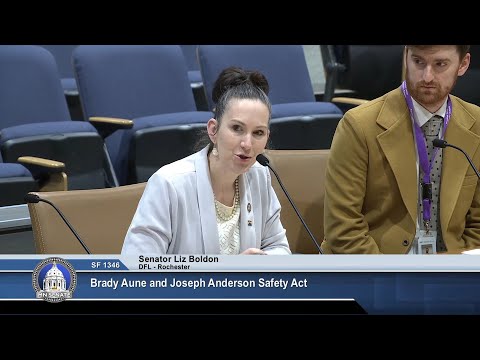
Senate File 1346, the "Brady Oney and Joseph Anderson Safety Act," was recommended to pass by the Minnesota Senate Finance Committee on March 20 after sponsor Senator Bolden said the bill responds to two recent drownings involving commercial aquatic-plant removal.
The bill would require people who use scuba gear while performing work that constitutes making improvements to land — including commercial lake aquatic plant removal — to hold scuba certification, carry specified safety equipment and comply with added worker-safety conditions in Department of Natural Resources (DNR) permits. It would also require the DNR to provide information to companies doing this work and allow the agency to revoke permitting privileges for companies that accrue one or more willful violations.
Senator Bolden, sponsor of Senate File 1346, said the bill was prompted by two fatal drownings. "This bill came to me through an email from 2 families, who were looking to make a change, because they had lost their sons. Brady Oney and Joseph Anderson," Bolden said, adding the legislation would "require those who are doing this work and using scuba gear to be trained, to get certification in scuba" and would add "necessary equipment" that could have prevented the deaths.
Committee staff presented a fiscal note showing modest one-time and ongoing costs that agencies expect to absorb. "There are relatively modest expenses from the workers' compensation fund at the Department of Labor and Industry and some general fund expenses at the Department of Natural Resources, all of which have been indicated that they can be absorbed," Mr. Nauman, a committee staff member who presented the fiscal note, said. The fiscal note identifies about $2,000 in general fund programming costs for the DNR in fiscal 2026 and a roughly $5,000 one-time increase for diving equipment and related training at the Department of Labor and Industry in fiscal 2026, with about $2,000 per year thereafter for that item.
Officials from the Department of Labor and Industry (DLI) told the panel the bill targets a specific activity and does not supplant existing federal regulations that cover other commercial diving occupations. "There are existing federal regulations that OSHA looks for when they go to sites that involve scuba diving," Josiah Moore, legislative director at the Minnesota Department of Labor and Industry, said. He added, however, that the bill's requirements would apply only when the work fits the bill's definition of "making improvements to land," meaning other types of commercial diving (for example, some underwater construction or public-safety rescue work) could remain governed by federal OSHA regulations.
Committee members asked whether other occupations that use scuba would be covered; DLI staff said some occupations such as underwater pile driving or underwater carpentry are likely covered by existing federal regs, while the bill's language will require case-by-case determinations where the activity's classification is unclear.
Senator Dames moved the bill be recommended to pass. After brief remarks endorsing the bipartisan, agency-led process, the committee approved the motion on a voice vote. Committee members recorded no opposition during the recorded proceedings; the chair declared the motion prevailed.
The sponsor said the authors in both chambers are working to reconcile minor language differences so the House and Senate versions align before the bill advances. The committee record shows Representative Brett Baker is the House collaborator on the measure.