Get Full Government Meeting Transcripts, Videos, & Alerts Forever!
Get email alerts on the Environment Pfas topic
No spam. Unsubscribe anytime.
Minnesota Senate Tax Panel Hears Proposal for 50% PFAS Gross‑revenues Tax, Lays Bill Over as Amended
Summary
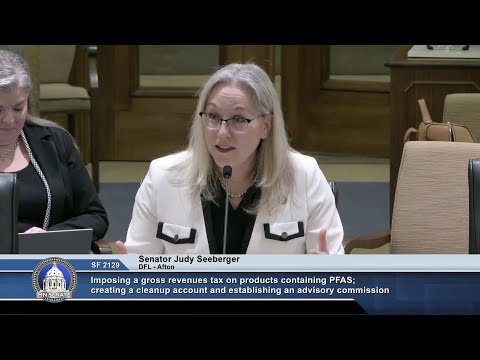
Senator Seaburger introduced Senate File 2,129, which would impose a 50% gross‑revenues tax on Minnesota manufacturers and retailers of PFAS‑containing products, create a PFAS cleanup account and establish an advisory commission; the committee adopted an A1 amendment and laid the bill over as amended.
Senator Seaburger, the bill author, told the Senate Taxes Committee that Senate File 2,129 would create a PFAS gross‑revenues tax, a PFAS cleanup account in the special revenue fund and a PFAS advisory commission. "This bill . . . establishes a PFAS gross revenues tax on manufacturers that produce products containing PFAS and retailers that sell products containing PFAS," she said, adding the measure would apply only to entities with nexus to Minnesota.
The bill, as explained section by section, would impose a tax equal to 50% of gross revenue derived from PFAS‑containing products sold by Minnesota manufacturers to distributors and a 50% tax on gross retail sales of PFAS‑containing products in Minnesota. Section 2, Senator Seaburger said, "creates a PFAS clean up account in the special revenue fund to provide funds for environmental clean up across the state," and requires annual deposits of amounts equal to funds raised by the PFAS tax. Section 3 would establish a PFAS advisory commission to recommend use of the funds; the panel would make an annual recommendation to the State Board of Investment and issue its first report by Dec. 15, 2026.
Why it matters: proponents said the measure implements a “polluter pays” approach to cover mounting cleanup costs that municipal water systems and private well owners now face. "Right now they're going to be constructing water treatment facility on all their 9 wells. And that construction is gonna cost $70,000,000," Seaburger said, describing needs in Hastings. Clean Water Action Minnesota’s state director Ivana Stark said the MPCA estimates cleanup costs in the “tens of billions” for wastewater alone and argued corporations should bear more of the cost: "We must stop letting those who can afford to clean up their mess off the hook."
MPCA and technical concerns: Tom Johnson, government relations director for the Minnesota Pollution Control Agency, told the committee MPCA has produced a PFAS removal report ordered by the Legislature and that the report lays out fee‑target approaches and reporting mechanisms the agency and stakeholders evaluated. He noted the cleanup account language appears to target remediation (soil cleanup) and lacks an explicit mechanism to transfer funds to drinking‑water infrastructure programs such as the Public Facilities Authority or other funds MPCA typically uses. "These are more technical issues and so, we're happy to work with the author and the committee to provide technical assistance," Johnson said.
Industry opposition: representatives from business and trade groups warned the proposed tax and reporting requirements would be disruptive. Brian Cook of the Minnesota Chamber said the proposed 50% gross‑receipts tax would "have serious financial consequences," arguing it could compound along supply chains and raise consumer prices. The Consumer Technology Association and trade groups representing retailers, vehicle dealers, marine manufacturers and HVACR firms highlighted essential product uses of PFAS, global supply‑chain reporting difficulties and exemptions that industry already claims are necessary for certain internal components or regulated goods. Several witnesses said alternatives are being pursued but are not universally available and that abrupt application could harm Minnesota manufacturers and retailers.
Committee actions and procedural status: Senator Weber moved the A1 amendment; the committee adopted the amendment by voice vote. Senator Seaburger asked that initial appointments to the advisory commission occur by Jan. 15, 2026, and that the commission hold its first meeting by July 1, 2026. After testimony and questions, the committee laid Senate File 2,129 over as amended.
Discussion versus decision: the committee did not adopt the bill on final passage; it adopted the A1 amendment and laid the bill over for further consideration. Multiple witnesses offered policy, technical and economic concerns the committee flagged for follow up, and MPCA staff recommended further technical review of how the cleanup account would interact with existing remediation and drinking water funding.
What to watch next: the committee and author acknowledged the bill needs additional work on revenue estimation and technical fixes. The Department of Revenue reported revenue impacts as "unknown" in the revenue estimate, and several testifiers urged additional study of reporting requirements and potential exemptions for critical products.
Votes and formal actions recorded in committee - A1 amendment to SF 2,129: moved by Senator Weber; adopted by voice vote (no roll‑call recorded). - SF 2,129: laid over as amended (no final passage in committee).