Get Full Government Meeting Transcripts, Videos, & Alerts Forever!
Get email alerts on the Historic Preservation topic
No spam. Unsubscribe anytime.
Grand Island commission begins work to pursue Certified Local Government status
Summary
The Grand Island Historic Preservation Commission heard a presentation from a state CLG coordinator about requirements, benefits and next steps for seeking Certified Local Government status and agreed to send its ordinance for review; no formal action was taken.
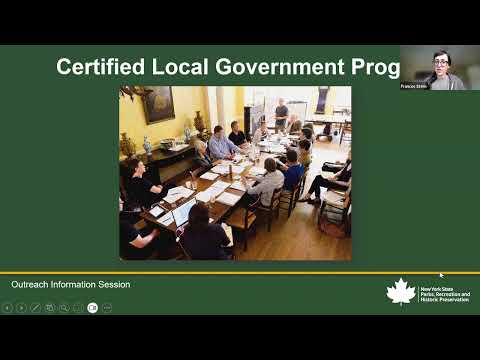
The Grand Island Historic Preservation Commission on April 16 heard a state presentation on pursuing Certified Local Government (CLG) status and agreed to forward its existing local ordinance to the state coordinator for a formal review.
The discussion centered on what the CLG designation requires, how it can enable grant funding and technical assistance, and what changes (if any) Grand Island’s ordinance and commission structure would need to meet state and federal standards.
Frances, the CLG coordinator with the New York State office, told the commission that “the certified local government program is actually a federally sponsored program. It's a partnership with the National Park Service and the State Historic Preservation Office.” She outlined core requirements: adoption of a local historic preservation ordinance, a qualified local preservation commission, a maintained survey/inventory of historic resources, annual reporting and periodic performance reviews. Frances said communities that become CLGs are eligible for targeted technical assistance and a share of federal funds passed through the state via the Historic Preservation Fund.
Commission chair Jim Crawford said the group had already prepared an ordinance and asked what came next. Frances replied she would perform a detailed review of the town ordinance and the qualifications of prospective commissioners and then help prepare the certification packet to submit to the National Park Service if Grand Island decides to proceed. She told the commission that the state requires annual CLG reports (due November 15) and a four‑year performance review process.
The coordinator stressed aspects the commission and public often misunderstand. She described how CLG communities administer preservation locally and said the commission can tailor its procedures to local needs, but that some elements are non‑negotiable under New York practice. “The ordinance has to specify that you have the authority to designate landmarks according to a series of criteria and that owner objection ... is not part of the process,” she said, noting that New York does not use an owner‑consent opt‑in system.
Frances also explained grant opportunities and other incentives tied to CLG status: a spring cycle of CLG subgrants from the state, funding for surveys, National Register nominations, design guidelines, digitizing records, and staff/commission training. She noted that nationally eligible tools — including the state’s model preservation law, National Register nominations, and the Historic Homeownership Rehabilitation Tax Credit — can be important complements to local activity. She told the commission she observed a few Grand Island resources as eligible for the National Register but not yet listed.
During the local discussion commissioners raised practical concerns and short‑term priorities. Several members said they want the commission to be in the review process for demolition permits and zoning changes so preservation staff can comment early. Members identified a state‑owned property on Grand Island and a privately owned residence as immediate interests and discussed a proposed preservation effort for Rose Cottage in Ferry Village. Sharon and another member said the Rose Cottage owner is “willing to work with us to do to save that building,” and the commission agreed to gather more information and possibly coordinate with the zoning appeals board if needed.
The commission did not take a formal vote on certification at the meeting. Instead it decided to send the existing local ordinance to Frances for review; she agreed to provide written comments and follow‑up guidance. Commissioners said they will also share the ordinance and Frances’s summary with the town board and municipal attorney to prepare for any required local approvals and public outreach. The commission discussed scheduling: members expect to review Frances’s comments before the next meeting and plan a follow‑up discussion in April with a possible May meeting reschedule noted.
No formal motions or votes on CLG certification were recorded during the session.
Frances recommended education and community outreach to address misconceptions that local preservation is overly restrictive; she recommended the commission consider design guidelines, a public information page linking to the code, and ongoing training for commissioners. The commission agreed that pursuing CLG status would help clarify what grants and tax incentives the town could pursue and would provide the “guts” for future local landmark and district work.
The commission’s next steps are to (1) send the adopted local ordinance to the state CLG coordinator for review, (2) have the coordinator return comments and a checklist for the certification packet, (3) share materials with the town board and municipal attorney, and (4) follow up at the next scheduled meeting to determine whether to proceed with a formal application to the National Park Service.
No formal decision to apply for CLG certification was made at the meeting.