Get Full Government Meeting Transcripts, Videos, & Alerts Forever!
Get email alerts on the Public Works Codes topic
No spam. Unsubscribe anytime.
Engineering staff review Chapters 151'155: right-of-way encroachments, off-site improvements, floodplain management and subdivisions
Summary
Assistant City Engineer reviewed codes for right-of-way permits, off-site construction improvements and developer reimbursement, floodplain review by the county flood control district, subdivisions and the city's design and development standards manual.
Assistant City Engineer Bryce Christo reviewed Chapters 151 through 155 during the March 18 work session, covering right-of-way encroachments, off-site improvement requirements, floodplain administration and subdivision procedures.
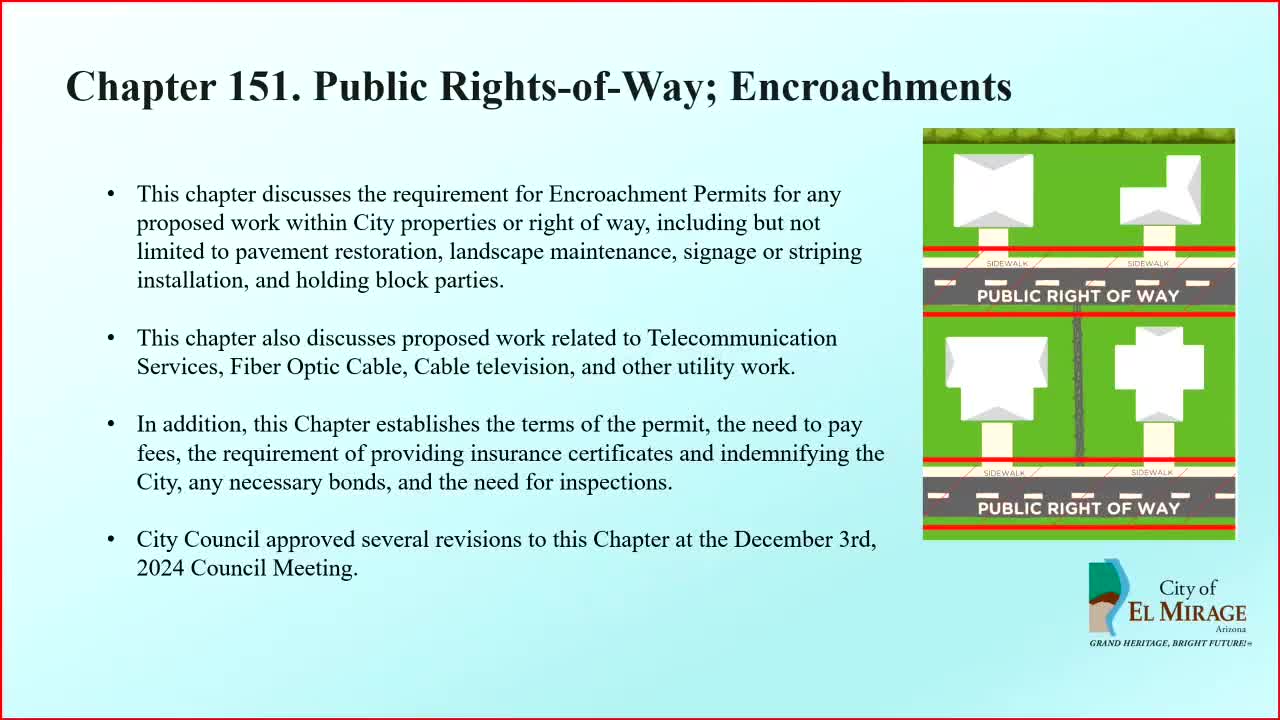
Christo said Chapter 151 requires permits for any construction or placement within the city right-of-way, including pavement restoration, landscaping, signs, striping, block-party barriers and wet or dry utilities; permits require fees, insurance certificates, indemnification and inspections. He noted the council previously reviewed these provisions at the December 3 council meeting.
Chapter 152 governs off-site construction improvements developers must build adjacent to their projects, such as half-street improvements, curb, asphalt, sidewalk, streetlights, traffic signals and utilities. Christo described additional developer-driven contract mechanisms in the code such as benefit studies, reimbursement agreements and accelerated public-improvement agreements; engineering staff are updating that section and plan to return to council with revisions in summer.
On floodplain management (Chapter 153), Christo said the city functions as its own floodplain administrator administratively, but the county flood control district is the responsible floodplain reviewer: the city forwards developer plans that encroach on floodplains to the county and will not release permits until county approval is obtained.
Chapter 155 covers subdivisions (preliminary and final plats). Christo described the difference: preliminary plats function as a preliminary site plan used to vet lot sizes, setbacks, easements, utilities and street layouts; final plats record legal easements and right-of-way dedications and become legally binding when recorded following council approval and mayoral signature. He said the city's design and development standards manual supplements the code and staff intend to revise the subdivision chapter to remove redundancies and bring it into alignment with the manual in late 2025/early 2026.
Councilmember Dorsey asked how the city ensures deferred improvements are completed; Christo said the city uses development agreements, letters of credit or bonds and provides timelines in agreements (for example, requiring completion within a year after a triggering event such as removal of conflicting utility poles).