Get Full Government Meeting Transcripts, Videos, & Alerts Forever!
Get email alerts on the Land Use Review topic
No spam. Unsubscribe anytime.
Loudoun committee reviews plan to implement land-use approval overhaul
Summary
County staff and consultant Alvarez & Marsal outlined an 18–24 month implementation plan to vet and act on 69 recommendations aimed at streamlining Loudoun County's land‑use review process; staff will return in June with a status report and recommended items for implementation.
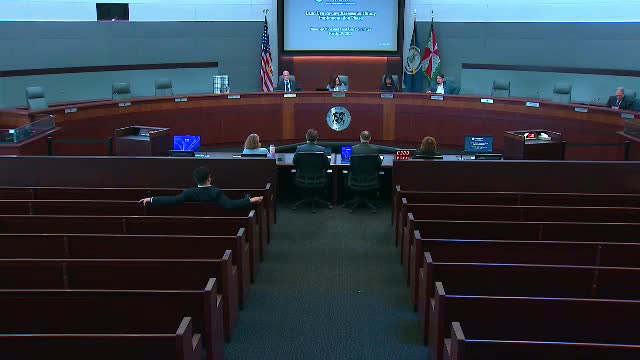
Loudoun County Transportation and Land Use Committee Chair Tacrone on March 19 heard a staff briefing on plans to implement a countywide land‑use review assessment that the board authorized after a December 2023 fund‑balance decision.
The study, completed by management consultant Alvarez & Marsal and presented to the board in late 2024, contains separate legislative and administrative recommendations staff are now vetting with departments, referral agencies and private‑sector residential and commercial representatives. Staff said they expect to complete initial vetting and return to the committee with a status report in June and to carry implementation work through task groups beginning in June and continuing in the following 18 to 24 months.
Why it matters: County officials said the review is intended to reduce permit backlogs, clarify responsibilities across nearly 40 referral agencies, and improve consistency, workforce capacity and technology in building and land‑use review processes. Several supervisors pressed staff to add procedural safeguards and stakeholder coordination—including automatically briefing the Planning Commission and continuing outreach to economic development and industry representatives—before any final decisions are forwarded to the board.
At the meeting, county staff and the consultant described how Alvarez & Marsal grouped recommendations into three strategy areasprocess, people and technologyand provided counts for the recommendations staff is vetting: 33 legislative recommendations and 36 administrative recommendations. Nancy Zelke, the Alvarez & Marsal consultant identified by staff as the project lead, and county presenters said the implementation effort will use a steering committee of department leadership, 10 focused task groups and continued engagement with the residential and commercial sectors.
Staff described a multi‑step vetting process: departments (including planning and zoning; building and development; county attorney; information technology) and private‑sector residential and commercial representatives will record their positions on each recommendation in a shared spreadsheet and in collective meetings. Those positions will be forwarded to the county administrator, who staff said will advise which recommendations should proceed. If staff recommends that the board not implement a consultant recommendation, staff said it will present justifications and seek the committee—s endorsement before any board action.
Supervisors asked for several clarifications and changes to the work plan. Vice Chair Turner asked how task groups and the steering committee will interact; staff said task groups will report to the steering committee, which reports to the county administrator. Chair Randall and others requested that the Planning Commission be added to the outreach and briefing schedule; staff agreed Planning Commission input will be added to the work plan. Supervisor Kershner asked that the committee retain access to historical staff comments in an electronic archive rather than printing long report appendices; staff said they plan to keep a linked archive and provide the most recent review in the staff report to reduce packet size. Kershner also raised bonds as a priority, and staff said the report recommends consolidating and simplifying categories of bonds rather than expanding the county—s bond requirements.
Committee members discussed whether to create a formal Development Review Committee (DRC) as recommended in the consultant report. Betsy (department name not specified in the transcript), a present staff member, said the task force will determine whether a DRC or another internal committee is the appropriate future state but that staff concurs something is needed to resolve multi‑review issues. Supervisors expressed concern a DRC could become a bottleneck and asked staff to evaluate alternatives and safeguards.
The board and staff also discussed external constraints. Staff noted House Bill 2660 (state legislation pending signature at the time of the meeting) shortens some review timelines for projects and state agencies; staff said that change will affect processing and resource planning and that they are tracking its implications. Staff confirmed the board added 10 positions in the most recent budget for planning and zoning and that some additions were in response to the study recommendations.
Staff said the work is being organized in four six‑month periods. The committee was told that period 1 (December 2024June 2025) focuses on completing vetting and establishing the steering committee and task groups, and that staff expects to return in June with a status report and a list of recommendations proposed for implementation.
Committee members encouraged using TELOC (the committee) and a TLU committee liaison (Vice Chair Turner was identified as a liaison) to receive updates and asked that complex or not fully developed applications be triaged to committee work sessions rather than resolved on the dais. Staff accepted that suggestion and invited supervisors to participate in task‑group briefings where appropriate.
The presentation and discussion were informational; no formal committee vote on implementation items was recorded at this meeting.
Next steps: staff will complete department and industry positions on the consultant recommendations, form the steering committee and task groups, continue negotiations to secure consulting support, and return to the committee in June with a status report and a list of recommendations for endorsement or rejection.