Get Full Government Meeting Transcripts, Videos, & Alerts Forever!
Get email alerts on the Grade Realignment topic
No spam. Unsubscribe anytime.
Parents and staff urge Perkiomen Valley board to pause proposed grade realignment
Summary
Dozens of parents, teachers and community members urged the Perkiomen Valley School District board to halt a proposed grade-level realignment, citing lack of data, longer bus commutes, special-education and inclusion concerns and insufficient teacher input.
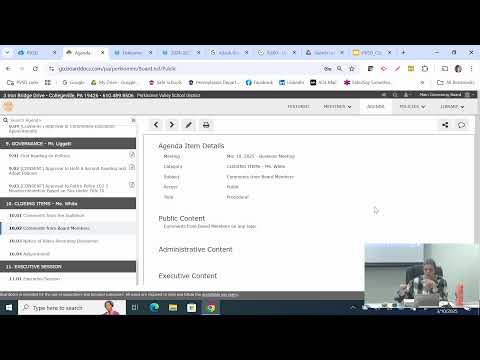
Dozens of parents, teachers and union leaders told the Perkiomen Valley School District board on March (public comment) that the district should halt or reconsider a proposed realignment that would move fifth graders to middle schools earlier than at present.
Bill McGill, president of the Perkiomen Valley Education Association, said staff want “an active role in shaping the structure and environment of the 5, 6 and 7, 8 buildings” and asked that final schedules and workloads be developed in collaboration with teachers. “Before staff are asked to complete their end-of-year placement survey, key details such as start and end times and whether they will be teaching all subjects or specializing need to be provided,” McGill said.
The proposal has drawn repeated questions about transportation. Multiple speakers said preliminary information about bus routes and commute times is incomplete and that some students could face rides of 45 minutes or longer, with earlier pickup times. Megan Cleveland, a Collegeville parent, said the county planning commission’s data had not been completed and asked, “How can we expect the board to make such a large, impactful decision without the actual information and data required to substantiate the problem in the long term?”
Parents and teachers also raised developmental and programmatic concerns about earlier transitions to middle school. Jessica Stevens, a Collegeville parent, cited research on transitions and said evidence does not show academic benefits from moving fifth graders to middle school. “Fewer transitions correlate with higher academic achievement and improved behavior,” she said.
Several speakers raised civil‑rights and inclusion issues. Jessica Stevens and others argued that specialized medical transports or separate vans for students with medical needs risk isolating those children; Stevens said that approach would “contradict the principles of inclusive education and violate the spirit of Section 504 of the Rehabilitation Act.” Valerie Drury said members of the LGBTQ and transgender community have a right to an inclusive environment and urged the board to uphold the district mission on inclusion.
Speakers pressed for more transparency on the district’s stated operational problems between “East” and “West” middle schools, asking administrators to identify the root causes and whether the realignment is the appropriate remedy. Several commenters said they have not met any parents who support the proposal and asked the board to pursue alternatives that address specific problems without a districtwide structural change.
Board President Laura White and Superintendent Dr. Barbara Russell responded to public concerns by announcing a working-session format on the proposal for Thursday evening, with topic-focused small groups on schedules, transportation, extracurriculars, enrollment trends and transitions. Russell said the administration remains “committed to working collaboratively with the Board, with our administrative team, continued conversations with our teachers, and our parents.”
The board did not take a formal vote on the realignment during the meeting. Board members and administrators repeatedly said the proposal is not scheduled to be implemented for the coming school year and that a county study, expected in mid‑April, will inform next steps.
The district opened the public‑comment period for about an hour; speakers represented parents from multiple elementary and middle schools, teachers’ association leadership, and citizens concerned about transportation, special-education services, sleep and extracurricular access for students.
Looking ahead, board leaders invited the public to a series of meetings and asked community members and staff to join Thursday’s working session to discuss the concerns raised.