Get Full Government Meeting Transcripts, Videos, & Alerts Forever!
Get email alerts on the Elections topic
No spam. Unsubscribe anytime.
House committee lays over secretary of state elections bill after adopting two amendments
Summary
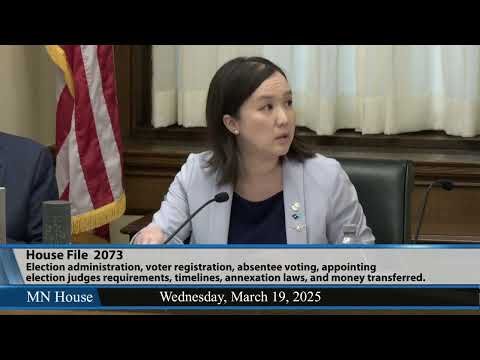
A House committee laid over House File 2073 — the Secretary of State's administrative elections bill — after adopting two technical amendments and discussing changes to absentee voting, election-judge lists and canvassing timelines. Several offered amendments were withdrawn for further work.
A House committee laid over House File 2073, the secretary of state's administrative elections bill, as amended, after adopting two amendments and withdrawing several others during a public hearing.
The bill, described at a high level by Mr. Gehring as ‘‘the Secretary of State's administrative bill,’’ bundles a series of changes to Minnesota election law, including changes to Election Day registration and proofs of residence, how permanent absentee lists are indicated, expanded options for absentee voting locations (including off-reservation tribal lands at a tribe's request), new requirements for candidate contact information, a county elections chain-of-custody plan requirement, and changes to canvassing timelines and certain grant-account transfers.
Why it matters: The bill touches multiple operational elements of how elections are run in Minnesota — from how absentee ballots are requested and mailed to the appointment and training of election judges and local canvassing rules. County officials and party representatives told the committee the provisions will affect workload and timelines for local election administrators.
Mr. Gehring, speaking for bill staff, walked through the bill section by section. He said the bill would, among other things, eliminate a residential-facility operator list requirement for Election Day registration and allow facility employees to self-attest employment for vouching; move the permanent absentee list checkbox to a different place on the registration form; adopt new envelope terminology; permit pop-up absentee voting on off-reservation tribal land at a tribe's request; require judicial-officer, county attorney and county sheriff candidates to provide an email address when filing; set a 28-day mail-out deadline for ballots in jurisdictions that conduct elections entirely by mail; and require county auditors to develop county elections chain-of-custody plans.
Michael Stahlberger, director of property and environmental resources for Blue Earth County representing MAKO (the association of county officials), told the committee MAKO supports many provisions but raised operational concerns. ‘‘Permanent absentee ballot requests are increasing in their number. They bring a significant amount of administrative workload with them,’’ Stahlberger said, urging continued conversations about how lists and timelines would be administered. He also said the proposed chain-of-custody requirement will add workload and asked for state support and templates. Stahlberger said counties were worried the bill's current 14-day response window for certain steps could be too short for training and administrative processing.
Committee action and amendments: The committee first adopted the A1 amendment by voice vote; Chair Freiberg said, ‘‘A1 is adopted.’’ Later the committee adopted the A7 amendment, which clarified language in the election-judge oath by referencing a Minnesota statute. Multiple other amendments were discussed but ultimately withdrawn for further drafting or negotiation, including A2, A3, A4, A5, A6, A8 and A9.
Several members probed operational details. Committee members and staff discussed how party-provided election-judge lists and caucus timelines interact with training and appointment schedules; whether the permanent absentee request checkbox should remain on the registration form or be a separate application; the administrability of contacting and exhausting party lists before hiring other judges; and whether prohibitions on intoxicating liquor at polling places should be expanded to include cannabis or other substances. Nonpartisan staff and Mr. Gehring advised that some of those changes will require specific statutory placements and careful drafting.
Outcome and next steps: The bill's author renewed the motion that House File 2073 ‘‘as amended be laid over for possible inclusion.’’ The committee laid the bill over for further consideration. No roll-call vote on final passage was recorded in the transcript; the committee used voice votes for amendments and procedural actions.
Looking ahead: Committee members said they expect additional drafting and stakeholder meetings on operational items — notably the handling of party election-judge lists, timelines tied to caucus season, chain-of-custody templates for counties, and cross-references to existing statutes before the bill returns to committee.