Get Full Government Meeting Transcripts, Videos, & Alerts Forever!
Get email alerts on the Social Media Youth Safety topic
No spam. Unsubscribe anytime.
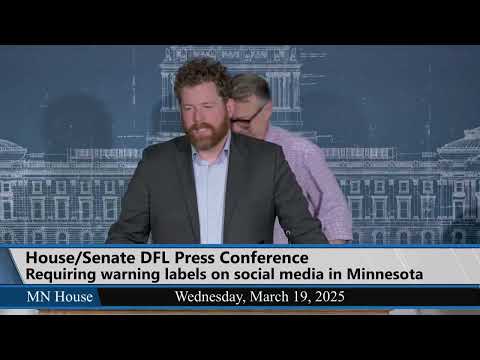
Minnesota lawmakers, families push bill for warning labels and 30‑minute timers on social media
Summary
A bill introduced by state legislators would require social media platforms to display warning labels and show pop-up timers every 30 minutes; parents who lost children to fentanyl-linked purchases on apps and suicide-prevention advocates urged action at a Capitol briefing.
ST. PAUL, Minn. — State lawmakers and family advocates on Monday outlined legislation that would require warning labels on social media platforms and mandate pop-up notifications every 30 minutes telling users how long they have been on the service.
Representative Zach Stephenson, who identified himself as a DFL member from Anoka and Coon Rapids and chair of the House Ways and Means Committee, said the bill implements a recommendation from the U.S. Surgeon General and aims to reduce the platforms' harms on young people. “The evidence is clear. Social media has a significant negative impact on mental health, particularly among kids,” Stephenson said.
The proposal would pair warning labels with a timer that generates a pop-up notification every 30 minutes to inform users of cumulative time spent on the platform. Supporters compared the approach to consumer warnings on tobacco and to “are you still watching?” interruptions used by streaming services to curb prolonged use.
Why it matters: Advocates and lawmakers argued that social media contributes to anxiety, depression, disordered eating and, in some cases, access to illegal drugs. At the Capitol event, two mothers described losing sons after they obtained pills through contacts made on social media apps.
Bridgette Noring, founder of the Devin J. Noring Foundation, recounted the 2020 death of her son, whom she said bought what he thought was a prescription pill on Snapchat that contained fentanyl. “That pill that Devin took contained enough fentanyl to... kill multiple people,” Noring said, urging legislators to require platform warnings and other reforms.
Tabitha Urbanski told lawmakers her 17‑year‑old son, Seth, died on Oct. 26, 2022, after buying pills through a contact on Snapchat. “At 07:38 a.m., I found my beautiful son sitting at the end of his bed dead,” Urbanski said. She said most purchases her son made during his fight with addiction were arranged via Snapchat and urged lawmakers to pass legislation holding platforms accountable and to limit minors' access to dealers.
Eric Michie, chief executive officer of SAVE (Suicide Awareness Voices of Education), said warning labels are one step among many needed to address harms on social platforms. “We don't rely on cigarette companies to police themselves. We don't trust alcohol companies to decide when kids should drink,” Michie said. “We shouldn't let the arsonist put out the fire.”
Senator Mann, who identified herself as representing Senate District 50 (Edina and Bloomington), cited research linking more than three hours of social media use per day with doubled risk of anxiety and depression among teens and said warning labels and other measures are a “bare minimum” to protect children. She also referenced a separate bill, Senate File 508, that would ban cell phones in classrooms as a related effort to curb excessive use among students.
Stephenson and other speakers noted the Minnesota attorney general, Keith Ellison, released a report documenting social media harms to youth and offering policy recommendations; they said they would coordinate with the attorney general’s office on follow-on legislation. Advocates acknowledged legal and political obstacles: Stephenson said big technology companies have powerful lobbies and that passing meaningful regulation is difficult.
No vote or formal legislative action occurred at the briefing. Stephenson said the House Commerce Committee would hold a hearing on the bill the following day. Supporters said the warnings and the pop-up timer are intended to add friction that may reduce compulsive use, and that the measures are modeled in part on tobacco‑warning strategies and other market interruptions.
Ending note: Organizers asked parents and the public to press lawmakers for action; several speakers said lobbying groups such as NetChoice oppose the measures and would spend to block them. The bill’s text, specific bill number for the warning-label proposal, and implementation details (enforcement mechanisms, exact label language, penalties, and whether the pop-up timer would be required for all users or only minors) were not specified at the briefing.