Get Full Government Meeting Transcripts, Videos, & Alerts Forever!
Get email alerts on the Residential Fuel Choice topic
No spam. Unsubscribe anytime.
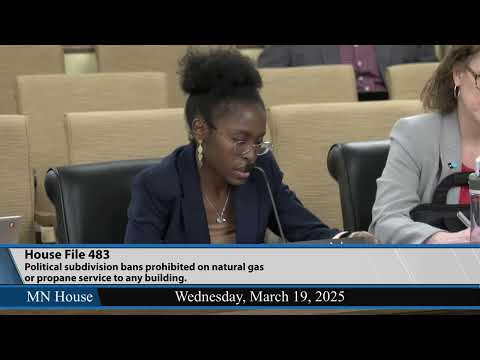
Committee hears bill to prevent local bans on natural gas hookups in new homes
Summary
The House Committee on Housing Finance and Policy also considered House File 484, a measure to prohibit local governments from banning natural gas hookups in residential construction.
The House Committee on Housing Finance and Policy also considered House File 484, a measure to prohibit local governments from banning natural gas hookups in residential construction.
Representative Mecklen (chairing the bill presentation) said the proposal has been offered in similar forms many times and described it as an "all-of-the-above" approach to household energy, noting rural reliance on natural gas or propane and limitations of some electric heat technologies in extreme cold.
Mark Foster, vice president of legislative and political affairs for Housing First Minnesota, testified in support on behalf of a home-building trade group of about 1,000 members. Foster said recent construction costs and a housing supply crunch make preserving fuel options for new homes important to affordability and predictability for builders. He cited U.S. Energy Information Administration data showing natural gas accounted for 65% of residential energy use in Minnesota in 2022.
Dave Wagner, executive director of the Minnesota Propane Association, also testified in favor, echoing reliability concerns and citing a regional 2024 risk assessment describing elevated risks in energy availability. "Reliable bulk power system requires generating resources to produce the necessary amount of energy to manage electricity demand at any given time," Wagner said, arguing that second fuel options like propane can sustain families during outages.
Members questioned the bill from a public-health perspective and on local control. Representative Nash asked trade witness Mark Foster whether the association had data on the percentage of new builds that include gas fireplaces, furnaces or stoves; Foster said his group had not surveyed members on that specific point but estimated a high prevalence, suggesting 80–90% of new builds include at least one gas appliance.
Representative Macklin expressed health concerns about byproducts from gas appliances and indoor air quality, noting studies that link gas combustion indoors to particulate and nitrogen oxide exposures. Supporters countered that modern direct-vent appliances and existing code requirements for smoke and carbon monoxide detectors mitigate many risks.
The committee laid House File 484 over for future consideration; no roll-call vote was recorded.