
Children First report: 26,400 Bucks County children identified as economically at risk; childcare, schooling and health gaps highlighted
Get AI-powered insights, summaries, and transcripts
Sign Up Free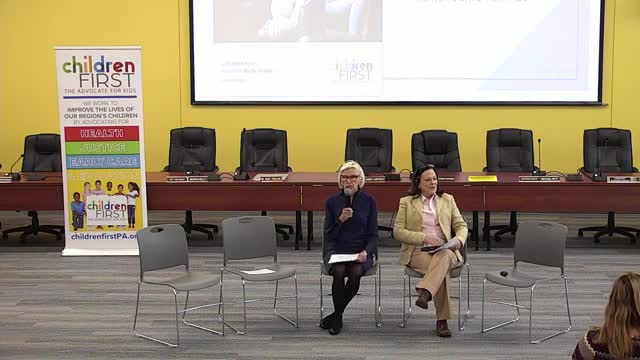
Summary
A new Children First report presented in Bucks County on Oct. 27 says 26,400 children in the county face economic barriers to thriving. The presentation detailed rising childcare costs, gaps in state education funding, declines in Medicaid enrollment and concerns about immunizations, lead screening and mental health access.
Children First presented findings from its report A Decade of Opportunities Stunted for Children in Bucks County on Oct. 27, saying 26,400 children in the county live in families whose economic circumstances put them at risk of falling behind.
The report's authors told attendees a two-parent household with two children would need about $86,268 annually to cover basics — housing, transportation, food and childcare — in Bucks County. Presenter Donna Cooper, executive director of Children First, said infant care costs in Pennsylvania rose about 30% in the past decade and that families paying market rates for childcare in Bucks County spend roughly 16% of their income on those costs, well above a federal benchmark of 7% cited in the presentation.
Why it matters: The presentation tied childcare affordability to workforce participation and upward mobility. Presenters and local officials warned that insufficient subsidies and limited childcare slots constrain parents’ ability to work, reduce incentives for wage growth or promotions, and trap families in low-income brackets.
Key findings presented
- Economic scale: The report identifies 26,400 children in Bucks County as living in families that cannot meet basic costs. Presenters used the Wells Fargo Center’s seating as a visual to describe that group’s size.
- Childcare access and cost: Presenters said only about half of eligible children can enroll in subsidized childcare because state and federal funding is insufficient. They reported a 30% rise in infant care costs over 10 years (statewide comparison cited) and that paying for childcare can consume about 16% of a family’s income in Bucks County.
- School funding and cyber charters: The presentation said school districts in Bucks County are collectively owed about $36 million by the Commonwealth of Pennsylvania under the state funding formula. Speakers also cited concerns about cyber charter schools, noting Attorney General and Auditor General reviews of several cyber charters and a claim in the presentation that some cyber providers have accumulated large cash reserves (the figure cited in the presentation was $618,000,000 across some cyber operators).
- Health coverage and immunization: Presenters said Medicaid enrollment among children in Bucks County fell from about 42,000 at the pandemic peak to about 39,000, and that the number of children in CHIP rose modestly from roughly 7,500 to 7,900 over a decade. The report said the share of children starting school without required vaccinations has doubled since 2016 in Bucks County and that Pennsylvania is reporting increases in vaccine-preventable illnesses such as whooping cough in some counties.
- Lead exposure and screening: Children First said 11,000 children in Pennsylvania tested positive for lead exposure last year and that roughly 82% of children in Bucks County are not screened for lead according to the presentation.
- Mental health: The presentation cited data that about 36% of high school students in the county self-report feeling sad, depressed or anxious daily; Children First estimated that translates to roughly 25,000 high school–age students countywide. Presenters also said mental-health provider capacity is limited (presentation cited a ratio of about one licensed mental health professional per 330 people in the county).
Presenters and officials
Donna Cooper, executive director of Children First, led the data walkthrough and emphasized the report’s ten-year perspective. Jackie Griffith, a member of the Children First board of directors, introduced the session and framed the county-level concerns. State Representative Jibre Prokopiak (140th District) attended and discussed state-level funding developments and the 2024 push to increase adequacy funding for schools.
Sponsor and next steps
Children First said it will use the report to inform local advocacy, expand outreach to school and health systems, and build coalitions on childcare affordability and children's mental health. The presentation invited attendees to follow-up webinars and local coalition work; Children First staff announced a webinar on March 11 to organize a coalition called Strong Minds, Bright Futures focused on children’s mental-health access.
Limits and sourcing
The presentation combined statewide statistics and Bucks County–specific figures; presenters noted when a statewide data point was used rather than a Bucks County figure (for example, the 40% of childcare workers who rely on SNAP/Medicaid was cited as a statewide statistic). Some financial figures cited in the presentation (for example the cyber charter cash-reserve total) came from recent audits noted by presenters; the presentation did not include underlying spreadsheets in the talk but referenced Attorney General and Auditor General reports.
What to watch
Children First and local officials encouraged community members to contact state lawmakers about continued education and childcare funding. The presentation singled out the need for sustained state funding to close an adequacy gap and for federal support tied to Medicaid, CHIP and childcare block grants to maintain childcare subsidies and related services.