Get Full Government Meeting Transcripts, Videos, & Alerts Forever!
Get email alerts on the Youth Intervention Programs topic
No spam. Unsubscribe anytime.
Committee hears testimony to shift YIP grants from public safety to children-and-families oversight
Summary
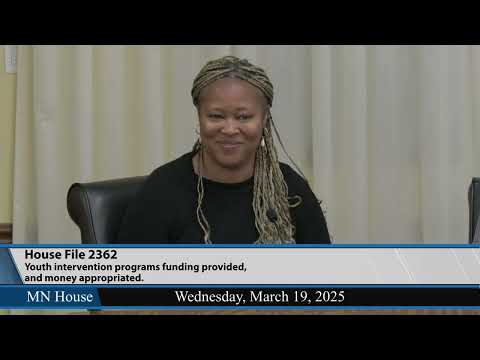
The Minnesota House Children and Families Finance Committee heard testimony on House File 2362, a bill to fund the Youth Intervention Program (YIP) grants and to move administration and funding emphasis from public safety to a children-and-families context; the bill was laid over for possible inclusion in the omnibus package.
House File 2362, a bill to fund the Youth Intervention Program (YIP) grants and emphasize youth intervention services under children-and-families administration, was presented to the Minnesota House Children and Families Finance and Policy Committee and laid over for possible inclusion.
Representative Emma Feist introduced the bill and described it as an effort to shift longstanding YIP funding out of the public safety realm and into the children-and-families policy area. "This is a really amazing program that funds youth intervention programs," Representative Feist said, noting the program's bipartisan origins and long history in the state.
Paul Meneer, executive director of the Youth Intervention Programs Association (YIPA), told the committee the grant program dates to 1976 and that YIPA formed in 1984 to support local programs. Meneer said YIP grants fund a wide variety of local interventions that, in his view, work by "building a trusting, caring relationship with a young person" and that smaller, local programs often produce large impacts. Meneer clarified that the association (YIPA) does not administer the grant, and that the Department of Children, Youth and Families (DCYF) handles grant administration.
Bernadette Pho, executive director of Mediation and Restorative Services, described the typical uses of YIP-funded restorative practices in schools. "Students learn to come to a mutually agreed upon solution," Pho said, and she cited outcomes the programs aim to affect, including school climate, truancy and suspension rates. Miranda Sheffield of the National Center for Youth Law framed the reallocation as an opportunity to "reimagine how we are addressing harm" and said moving funding to children-and-families could create new restorative pathways and preventive approaches.
Committee members asked about evidence and outcomes. Meneer pointed to a YIPA outcome survey that uses protective factors from the Search Institute and reported findings such as a majority of participating youth saying programming helped them make better decisions and accept accountability. He also described a local longitudinal study, shared at the hearing, in which a Youth Service Bureau partnered with Washington County and found a 90 percent non-reoffense rate the year after program participation for referred youth. Representative Feist and members emphasized the existence last term of an Office of Restorative Practices and noted that the bill would complement that work.
Representative Nelson and other members described local programs in their districts—Pine County and Minneapolis were cited—while Representative McDonald and others asked whether named local providers (for example, The Bridge for Youth and Sister Rita's House) receive YIP funding; Meneer confirmed those organizations were among approximately 98 grantees currently funded under the program.
The committee did not vote to refer the bill to a different committee; House File 2362 was "laid over for possible inclusion." No specific appropriation or statutory text change was finalized in committee during the hearing.
Why it matters: Committee members framed YIP funding as an upstream investment intended to reduce juvenile justice involvement, decrease truancy and produce long-term savings by preventing deeper system involvement. Supporters urged sustained funding to enable local programs to serve more youth.
Provenance: The discussion began when Representative Feist introduced HF 2362 and ended when the chair announced the bill was laid over for possible inclusion.