Get Full Government Meeting Transcripts, Videos, & Alerts Forever!
Get email alerts on the Food Safety Phthalates topic
No spam. Unsubscribe anytime.
Committee advances bill to require phthalate testing of packaged foods; reporting requirement narrowed
Summary
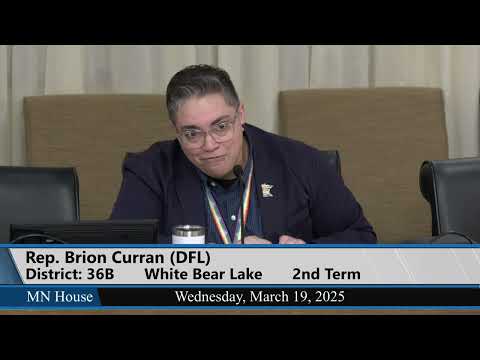
House File 44, authored by Representative Emma Curran, would require food manufacturers to test packaged food products for ortho‑phthalates and make the test results publicly available.
House File 44, authored by Representative Emma Curran, would require food manufacturers to test packaged food products for ortho‑phthalates and make the test results publicly available. The House Agricultural Finance and Policy Committee adopted an author's A1 amendment that removed a requirement to file results with the Minnesota Department of Agriculture and laid the bill over for possible inclusion in a future bill.
The bill prompted lengthy testimony from health professionals, consumer advocates and business groups. Proponents said testing and public disclosure are a minimal, necessary step to inform consumers and spur product changes. Lori Olinger, testifying for the Coalition for Plastic Reduction, said Consumer Reports found phthalates leaching into foods and argued that testing once every two years and publishing results would give consumers information they currently lack. "Consumers have the right to know what's in the food they buy," Olinger said. Health professionals, including Hannah Resendiz Olson and Dr. Zeke McKinney, described phthalates as endocrine disruptors linked in studies to reproductive and other health harms and said exposures are pervasive enough to merit action.
Supporters pointed to Consumer Reports' 2024 tests, which found phthalates in many packaged products, and to Minnesota Department of Health listings that flag multiple phthalates as chemicals of concern.
Business groups and agricultural representatives urged caution. Darren Broton of Minnesota AgriGrowth told the committee the bill in its earlier form was "unworkable" for four reasons, including absence of agreed health‑based food concentrations for phthalates in U.S. policy and the risk that publishing concentrations without such health benchmarks could produce misinformation or trigger litigation. Andrew Morley of the Minnesota Chamber of Commerce cited practical concerns including laboratory capacity, costs for small producers and the difficulty of establishing the source of trace phthalates (packaging, processing equipment, or environmental contamination).
Representative Curran said the bill's immediate goal is information gathering rather than punitive measures: "We're not asking for new packaging immediately. The main goal t this time t the core is getting the information, having products tested, and making that information available to the public." She said she would be open to changing the implementation date and to using existing, reliable testing data where possible to avoid burdening small businesses.
Committee members pressed about next steps if tests are positive, and Curran said establishing health thresholds could be a later step after gathering data. Members also asked whether third‑party apps or existing data sources could be used; Curran expressed willingness to consider such options. Several members reiterated concerns about federal processes: witnesses noted the FDA's ongoing review of several phthalates and Consumer Reports' role in documenting current levels.
The committee adopted the A1 author's amendment by voice vote; the amendment removed the statutory requirement to report results to the Department of Agriculture while retaining the public‑disclosure emphasis. Representative Curran renewed her motion that HF44, as amended, be laid over for possible inclusion in a later bill. The committee laid the bill over.