Get Full Government Meeting Transcripts, Videos, & Alerts Forever!
Get email alerts on the Traditional Healing Medicaid topic
No spam. Unsubscribe anytime.
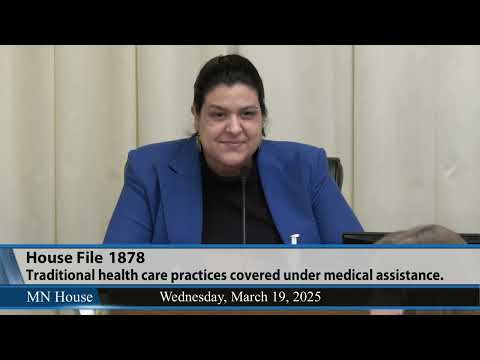
Committee hears bill to let Medicaid pay for traditional Indigenous healing practices
Summary
The House Health Finance and Policy Committee heard testimony on House File 1878 to allow payment for traditional healing services through Medicaid, with advocates urging use of Section 1115 authority and witnesses describing clinical and community benefits. The bill was laid over for possible inclusion in an omnibus bill.
Representative Keeler introduced House File 18 78, a proposal to allow Medicaid reimbursement for traditional Indigenous healing services, and the bill was laid over for possible inclusion in an omnibus bill.
Advocates and clinical leaders told the committee that traditional healing is already practiced in urban Indian health settings and that formal payment would expand access. "This is for just traditional healing, through the Medicaid services system," Representative Keeler said, adding that the proposal is “not a new idea” and that other states have adopted similar approaches.
Dr. Patrick Rock, a family physician and CEO of the Indian Health Board, told the committee the organization is asking the state to pursue a Section 1115 Medicaid waiver to allow payment for those services. "Today I'm representing the Indian Health Board... seeking an 11 15 waiver to allow for payment for traditional healthcare services," Rock said, describing the Indian Health Board as one of 41 urban Indian health programs nationally and noting limited federal funding relative to urban Native population counts.
Naomi Anewash, Indigenous Services Manager at the Indian Health Board, gave personal testimony about cultural practices she and clients use for mental and physical health, including traditional dances, ceremonies and food practices. She described improvements among community members in stress, isolation, diabetes and hypertension.
Kathy Gomez, representing the Birth Justice Collaborative, supported the bill and summarized research cited by testifiers: "Traditional healing practices take a holistic approach to addressing the physical, mental, and spiritual needs of their community," she said, and recommended expanding access beyond American Indian communities.
Committee members asked about evidence of outcomes; witnesses referenced studies and assessments, including work from the National Council for Urban Indian Health and a 2012 White Earth needs assessment conducted by the Minnesota Department of Health. Dr. Rock said meta-analyses and program evaluations have shown positive effects, particularly in behavioral and chemical-health outcomes, but did not provide numeric effect sizes during testimony.
No formal vote was taken on the substance of the bill. The chair said the bill would be laid over for possible inclusion; no implementation timeline was set.
The committee transcript shows support from community providers and program leaders, and signals further work with state agencies would be needed if the Legislature moves forward with seeking a Section 1115 waiver.