Get Full Government Meeting Transcripts, Videos, & Alerts Forever!
Get email alerts on the Small Community Capacity Building topic
No spam. Unsubscribe anytime.
House proposal would continue University-led program helping towns under 15,000 build project capacity
Summary
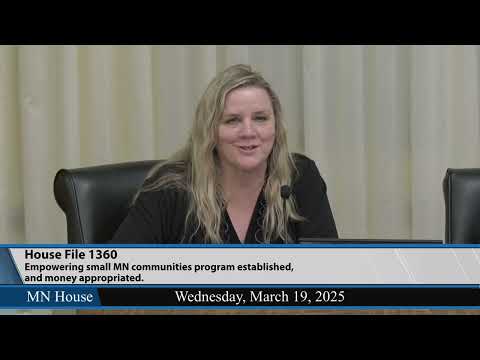
Chair Cagle moved House File 1360 to be laid over for possible inclusion; the bill seeks continued funding for the University of Minnesota–coordinated Empowering Small Minnesota Communities program, which provides technical services and planning support to towns under 15,000.
Chair Cagle moved House File 1360 to be laid over for possible inclusion in the omnibus bill. The bill would continue the Empowering Small Minnesota Communities (ESMC) program, a University of Minnesota–coordinated grant/service effort that helps towns under 15,000 build capacity to develop infrastructure, energy, water and other projects.
The University of Minnesota’s Kyle Shelton, director of the Center for Transportation Studies, told the committee the program grew from a 2023 pilot and has supported roughly 45 communities in the first round, with a dozen more pending in round two. “This program really began in 2023…around a clear need for additional capacity around infrastructure projects,” Shelton said, noting projects have ranged from local streets and downtown economic development to water systems, energy efficiencies, landfills, parks and trails.
Local officials described tactical outcomes. Carrie Kirschbaum, community development director for Crookston, said the program helped her city run community outreach and secure grants: “We have trails going. We have community meetings now every week,” she told the committee. Daniel Undum, city administrator for Lindstrom, said the grant enabled planning work to reconnect Beach Park with the downtown and improve stormwater treatment. Glenn Castor, a Bridgewater Township supervisor, described a $50,000 grant to study PFAS removal from landfill leachate and said the university team provided technical approaches the township could not have pursued on its own.
Committee debate focused on funding source and program duration. The bill as amended (author’s A1 amendment) would take initial funding from the Transportation Advancement Account (TAA), specifically the small-cities portion of Minnesota Statutes 174.49 as modified for the first two years, before switching to the small-cities portion of the TAA once certain thresholds are met. Representative Olsen and other members pressed that taking money from the small-cities allocation might divert funds from the smallest cities; Representative Kosnick and the bill’s author said they were open to finding a different longer-term funding source.
Members also debated whether the appropriation should be one-time or ongoing. Representative Kosnick offered an A2 amendment proposing a one-time appropriation to avoid adding to structural deficits; that amendment was withdrawn after discussion. Representative Olson offered an A3 amendment to remove the ongoing appropriation language; the committee took a roll call and, after committee clarification about the required majority under a power-sharing agreement, the amendment did not prevail. Chair Cagle then renewed her motion and HF1360 as amended was laid over for possible inclusion.
Why it matters: lawmakers and community leaders described ESMC as a way to make small, often understaffed jurisdictions more competitive for bonding and federal funding by giving them access to university technical teams and community-engagement processes. Committee members said the program can help get projects “fully baked” before state or federal dollars are sought, but some members warned against diverting existing small-cities transportation funds.
Votes and formal actions recorded in the hearing: Chair Cagle moved HF1360 be laid over for possible inclusion; the committee adopted the author’s A1 amendment (voice vote) and later laid HF1360 as amended over for possible inclusion. The A2 amendment was withdrawn. The A3 amendment (to convert the program to a one-time appropriation) failed to secure the necessary majority after a roll call and subsequent clarification of the committee’s voting threshold; it was not adopted.
Local officials asked for continued funding so new communities could access services and to support follow-on tasks when projects near readiness. Shelton described the program’s process as community-led: the community sets the scope and university teams respond and refine the scope until the community approves the next steps.
Looking ahead: HF1360 will be carried forward as amended for further negotiation on funding source and scope in omnibus negotiations. Committee members signaled willingness to continue working with the author to identify a sustainable funding source and to refine eligibility so the smallest cities retain access to funds.