Get Full Government Meeting Transcripts, Videos, & Alerts Forever!
Get email alerts on the Budget Long Range topic
No spam. Unsubscribe anytime.
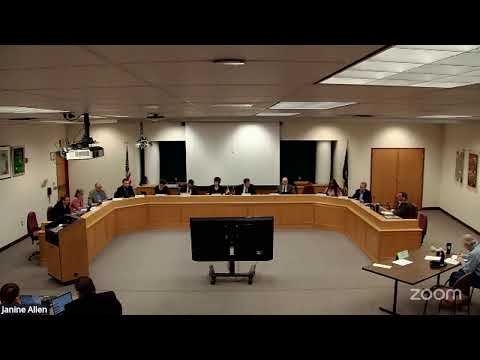
East Penn SD reviews long-range fiscal and capital plan amid projected multi-year deficit
Summary
The East Penn SD Board received a detailed long-range fiscal and capital plan March 10, with administration warning of a structural deficit for 2025-26 and projecting declining fund balances by 2029-30. Board members asked about assumptions, state and federal funding uncertainty, and charter school tuition pressure.
Emmaus — The East Penn SD Board of School Directors received a detailed presentation March 10 on the district’s long-range fiscal and capital plan, during which administration said a structural deficit of about $1.9 million exists for fiscal year 2025-26 and projected fund balances decline through 2029-30 under current assumptions.
Business manager Michael Saul reviewed audited prior-year figures, the current-year revised estimate and projections through 2029-30. Saul said local receipts and state funding have so far outperformed last year’s approved budget — producing roughly a $1.7 million positive variance in overall revenues and about $1.9 million more in state revenue tied to changes in basic education, special education and a new adequacy funding line — while federal allocations are about $283,000 lower than budgeted.
The presentation explained how the plan is constructed: prior audited figures, the 2024-25 revised budget, updated estimates and a proposed 2025-26 budget, then multi-year projections based on a set of assumptions. Saul highlighted a small current-year expenditure variance (about $260,000) and said the planned 2024-25 deficit has declined from roughly $2.0 million to about $500,000 after updated estimates and use of some one-time reserves for technology and other items.
Nut Graf: Why it matters — The board was presented with scenarios that show the district’s ability to sustain current service levels is sensitive to property tax limits (the Act 1 index), state funding trends and ongoing uses of fund balance for technology and capital work. Under the plan’s baseline assumptions, the combined general fund and capital reserve balances decline and approach a negative position by the 2029-30 projection year unless structural changes are made.
Saul walked board members through key assumptions that feed the projections: flat interim real estate tax estimates, earned income tax growth that tapers over the multi-year horizon, interest income assumed roughly level as rates moderate, and use of average increases for basic education and special education funding going forward. He also described exceptions where historical averages were not applied (for example, certain college tuition and transportation contract increases).
The capital plan and capital reserve were a major focus. Saul reviewed planned facility projects over the next 10 years (roofs, chillers and other “somewhat significant” capital needs) and the funding interaction between the general fund and the capital reserve. He said the administration is timing and sequencing projects to avoid concentrating large projects in a single year and that the district is currently about $1.1 million below a commonly used capital-contribution target because some capital reserve funds are being drawn down to cover planned projects.
Board members pressed administration on how the district evaluates assumptions and on contingency planning for uncertain state and federal funding. Doctor Whitney asked how assumptions get back-tested; Saul described a methodical review of current-year revenues and expenditures and a more granular review of assumptions as updated information becomes available. Board member Michael Jankowski asked how administration mitigates the risk from uncertain state and federal funding; Saul said staff meet with local legislators for context, and that midyear adjustments and use of budgetary reserves are options if allocations change unexpectedly.
Charter school tuition and enrollment also arose in questions. Saul said the district cannot change the statutory funding mechanism but noted increased legislative attention and a recent state audit of cyber charter finances that has heightened scrutiny statewide.
Saul summarized the plan’s scenario analysis: three starting scenarios for 2025-26 (0%, 2% and 4% tax increases) with iterations that evaluate steady subsequent years, the average tax increase needed to reach a 5% fund-balance target by 2029-30, and outcomes if projected Act 1 index limits are applied. He cited a sample metric using the average assessed residential value of $215,749 to illustrate household tax-bill changes (about $181 at a 4% increase, $135 at 3%, $90 at 2%).
Board discussion emphasized next steps: administration will continue revising assumptions with updated data in the coming weeks, present prioritized new expenditure requests (the slide listing district priorities was redacted and expected to appear in a future meeting), and work toward solutions to reduce the structural deficit.
“Because we’ve used a combination of historical averages and professional judgment, this is our starting point,” Saul said. “We have to continue to look at these assumptions and make adjustments where appropriate.”
The presentation prompted no immediate board action; questions and follow-up requests were assigned to administration for future meetings.
Ending: The board will review additional budget detail and prioritized expenditure requests in upcoming meetings before adopting a final budget in June.