
Redondo Beach staff walk commission through certificate-of-appropriateness process under preservation ordinance
Get AI-powered insights, summaries, and transcripts
Sign Up Free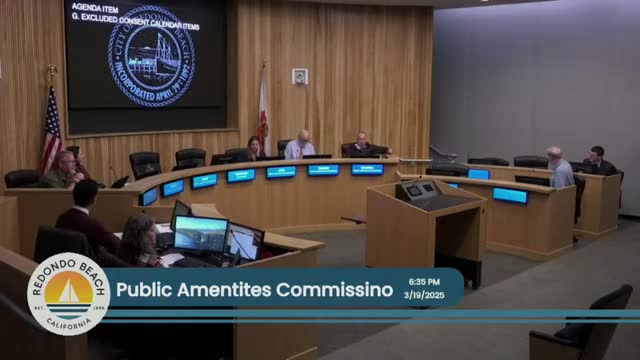
Summary
City planning staff told the Public Amenities Commission how the preservation ordinance is applied and which projects require a certificate of appropriateness; the commission received and filed the minor alterations subcommittee report.
City of Redondo Beach planning staff gave a step‑by‑step overview of how the city reviews proposed changes to historic resources and what triggers a certificate of appropriateness under the preservation ordinance.
The presentation by Andrew Swiatek, senior planner, reviewed three levels of review: (1) staff review for routine and non‑visible alterations, (2) the minor alterations subcommittee for smaller exterior changes, and (3) full commission review for major exterior alterations, additions and demolitions. Sean Scully, planning manager, introduced the briefing and said staff prepared the summary after the minor alterations subcommittee met earlier in March.
The overview matters because the city has properties in two historic districts, properties designated as landmark, and other “potentially significant resources” identified in the city’s historical survey. Swiatek said the survey grades properties A–D and that A or B properties may be subject to review even if not formally landmarked.
Swiatek summarized typical staff‑level work as interior alterations, maintenance and exterior changes not visible from the public right‑of‑way, and said the basic standard is “like for like” when materials and aesthetic elements are replaced. He told commissioners the minor alterations subcommittee commonly sees roofing changes, color and masonry work, new fences, gates, accessory structures, signs and landscaping; the subcommittee may defer items to the full commission. He said the full commission handles structural additions, new structures and demolitions.
Commissioners asked for a copy of the summary slide deck for the commission’s resource materials; staff agreed to provide it. Commissioners also sought clarification about the relationship between landmark designation, the Mills Act and the certificate of appropriateness process; Swiatek said landmark designation generally precedes Mills Act participation and that Mills Act tax contracts require maintenance consistent with a certificate of appropriateness.
The commission moved and approved a motion to receive and file the minor alterations subcommittee report and staff presentation. The motion was adopted by voice; there was no recorded roll‑call objection.
The presentation and the subcommittee report are intended to guide how the commission and staff handle future COA applications and demolition requests as the city updates its historic resource survey.