Get Full Government Meeting Transcripts, Videos, & Alerts Forever!
Get email alerts on the Stormwater Management topic
No spam. Unsubscribe anytime.
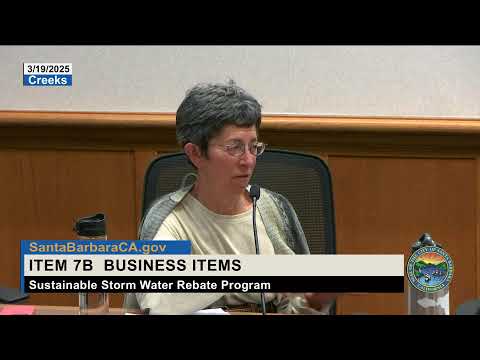
Santa Barbara Creeks Division outlines stormwater program, launches pilot rebate for on-site stormwater measures
Summary
Creeks Division staff reviewed the city's stormwater management program, reported response and compliance metrics, described an impending trash-capture permit requirement, and announced a new pilot rebate program for voluntary measures including disconnected downspouts, rain barrels and rain gardens.
City Creeks Division staff briefed the Santa Barbara City Creeks Advisory Committee on the Storm Water Management Program (SWMP), described the division’s compliance and monitoring work over the last fiscal year, and introduced a new pilot sustainable stormwater rebate program for voluntary on-site measures.
Jim Rumbly, presenting the SWMP overview, said the program implements the city’s municipal stormwater permit and includes six primary components: construction runoff control; illicit discharge detection and elimination; outreach; post-construction standards; water-quality monitoring; and trash capture. Rumbly said the city tracks “about 200 plus measurable goals” for the permit’s annual report and that Creeks Division staff are the coordinating unit for permit compliance.
Rumbly cited recent metrics: 105 illicit-discharge reports received and responded to within the agency’s 24-business-hour response time last fiscal year; about 100,000 pounds of trash removed from creeks and beaches in a typical year; and 1,487 post-construction plan reviews by Creeks Division staff in the last fiscal year. He said the city receives many proposals for post-construction compliance tools — permeable pavement, bioretention, underground storage chambers, cisterns and retention basins — and described the tiered post-construction regime used to size requirements. Rumbly said tier 4 projects are those that propose at least 15,000 square feet of new or redeveloped impervious area and would be required to retain the 2.4-inch, 24-hour design storm on site.
Rumbly also reviewed a newer permit requirement focused on preventing trash 5 millimeters and larger from entering the storm system in identified priority areas. He said the requirement must be fully implemented by a date cited in the presentation (staff cited 02/19/2030 in the slide deck), and that the city is evaluating structural measures (for example, continuous deflective separation units) versus enhanced street sweeping and targeted cleanups to meet the standard.
Rumbly said the municipal permit is overdue for replacement — the current permit dates to 2013 — and that staff had received an informal draft of a new statewide municipal stormwater permit in September; a formal draft was expected in spring or summer, with adoption projected in late 2025 and an effective start for the next fiscal cycle on July 1, 2026.
Following the program briefing, Erin Markey, Creeks manager, described a new Sustainable Stormwater Rebate Program launched the week before the meeting. The pilot offers reimbursement-style incentives for voluntary measures that do not trigger a building permit. Program highlights described by staff:
- Disconnected downspouts: $250 rebate for redirecting roof downspouts to landscaping rather than to piped connections to the street. - Rain barrels: up to $200 per barrel on a reimbursable basis; program materials indicate a typical qualifying barrel range of roughly 5–200 gallons depending on site constraints (staff will verify sizing in site visits). - Rain gardens: $3 per square foot for qualifying rain-garden depressions (4–18 inches deep) with stackable incentives when combined with other city water-conservation rebates (applicants could reach up to $5 per square foot when combined measures apply). - Removed hardscape: $2 per square foot for replacing eligible hardscape (minimum 20 square feet; cannot be driveway items that trigger building permits).
Markey said the program requires an initial online intake form and a site visit to confirm feasibility; applicants sign a simple agreement at the visit and submit receipts and photos after completion for reimbursement. She said the program is intended to be voluntary and stackable with other city rebates and that, after the initial rollout, staff will continue outreach through city newsletters, social media and events such as Earth Day. Markey reported 11 applicants and five site visits in the first week.
Committee members asked operational and policy questions that prompted staff clarifications: how clogged storm-drain covers and leaf litter are handled (report via SB Connect for crew or contractor response); maintenance needs for permeable pavement (vacuum-cleaning to restore porosity); options and trade-offs for underground storage chambers (plastic chambers are common and cheaper; concrete options exist but cost more); and how the program accounts for fire-safety guidance (committee members advised caution about flammable materials near structures and suggested coordination with local Firewise/Fire Safe Council guidance). Staff said plants used for rebate-supported landscaping must be water-wise and noninvasive and noted resources for native-plant guidance.
Why it matters: the SWMP sets compliance obligations tied to state and regional permits; the rebate pilot aims to increase voluntary on-site stormwater controls that reduce runoff, pollutant loads and immediate flood peaks while engaging residents and property owners.
No binding policy or budget decision was made at this meeting; the stormwater program item was presented for information and committee questions. Earlier in the meeting the committee approved minutes from the Feb. 19 meeting (motion carried; tally: yes 5, abstain 1).