Get Full Government Meeting Transcripts, Videos, & Alerts Forever!
Get email alerts on the Historic Context Statement topic
No spam. Unsubscribe anytime.
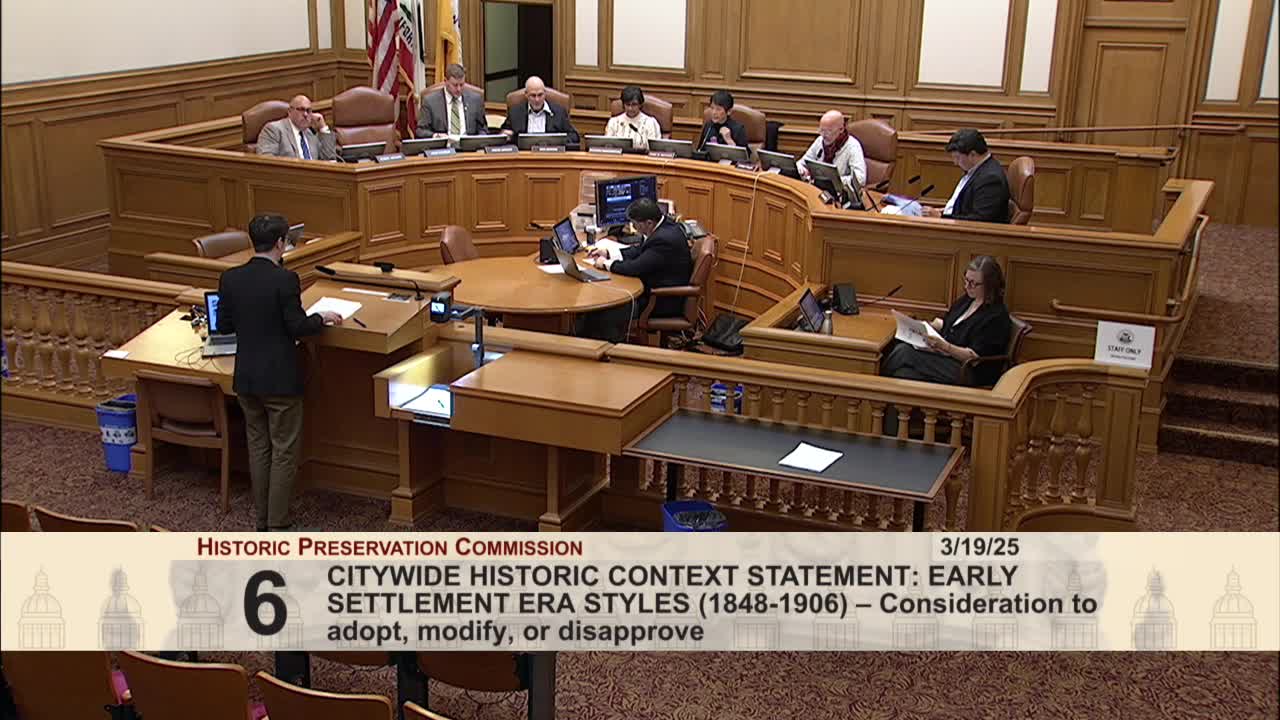
Commission adopts Early Settlement Era historic context statement for San Francisco
Summary
The Historic Preservation Commission adopted the citywide 'Early Settlement Era Styles' historic context statement, a staff‑prepared framework to guide evaluation of 19th‑century resources and inform future landmarking and survey work.
The San Francisco Historic Preservation Commission voted unanimously on March 19 to adopt the Early Settlement Era Styles historic context statement, part of a larger citywide cultural resources survey intended to guide consistent evaluations of older structures.
Alex Westhoff, Planning Department staff, said the document covers building types and architectural styles from the Gold Rush period (circa 1848) through the 1906 earthquake and fire. He told commissioners the statement identifies character‑defining features, notable examples and evaluative frameworks that staff will use to determine whether properties meet preservation criteria under federal, state and local standards.
Westhoff said the document addresses three early styles — including Greek Revival and Carpenter Gothic — and notes that extant examples are increasingly rare because of demolition and the 1906 disaster. He said evaluative thresholds for integrity are set lower than for later styles, to account for age and historic loss, and that modest vernacular examples may qualify as historic resources.
Public comment included architectural historians and preservation advocates. Bridget Maley, a preservation commentator, thanked staff for the work but recommended additions to the bibliography, offering a list of sources she said are key to the era and asking to meet with staff to refine citations. “There are at least nine sources that I would say are key to this era that are not included,” Maley said, adding she is willing to consult with Planning Department staff on revisions. Several commissioners echoed appreciation for the document and described it as a useful, living resource.
After a motion and second, the commission voted. “So moved, commissioners, that motion passes unanimously 6 to 0,” the chair announced.
Commissioners and staff said the context statement will support future survey work, property evaluations, and potential landmark nominations and that staff will keep the document under review as new research and public input arrive.